
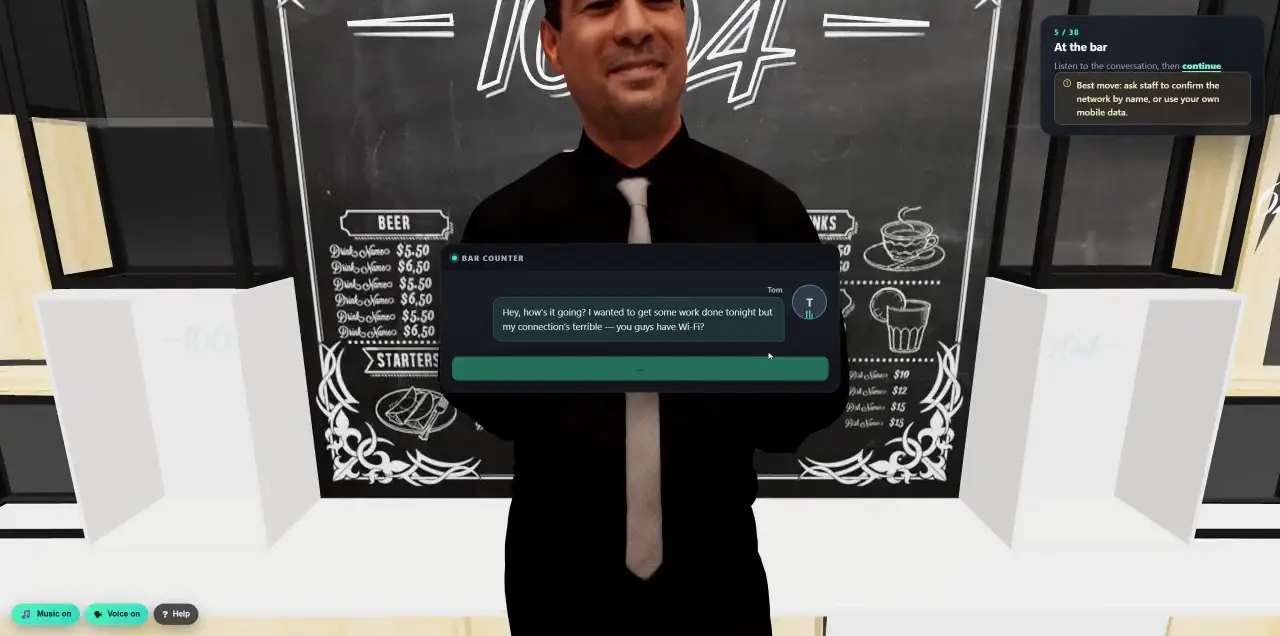
 Walk into a 3D lesson.Watch a learner go through the bar scenario, step by step.
AI-Powered Security Awareness Training is one way organizations can prepare employees to recognize cyber risks that extend beyond traditional computers and email. On November 2, 2026, multiple European supermarket chains reported disruptions affecting refrigeration and freezer systems, following a similar incident in France in October. The attacks demonstrate how connected operational technology can create real-world business consequences when remote control systems are compromised. They also highlight why organizations need coordinated technical defenses, clear incident procedures, and employees who understand their role in cybersecurity.
According to BleepingComputer’s report on the European supermarket refrigeration attacks, the incidents affected retailers in several European countries. Although investigators have not established whether all incidents were connected or identified those responsible, the reported disruption offers important lessons for cybersecurity teams, retail operators, and organizations that depend on connected physical infrastructure.
What Happened in the European Supermarket Cyberattacks?
On November 2, retailers across Belgium, Sweden, Luxembourg, Ireland, Estonia, and the Netherlands reported problems with refrigeration systems. Public reporting described unauthorized changes to freezer temperatures and refrigeration controls, with some units shut down or placed into defrost mode.
Affected organizations included Ahold Delhaize, Carrefour, Colruyt, ICA, Coop, Musgrave’s SuperValu stores, and Estonia’s Selver. The reported impact varied by retailer and location. Some stores removed chilled and frozen products from sale, while others worked with technicians to restore normal refrigeration.
The incidents followed a separate attack in France reported on October 12, when attackers reportedly manipulated refrigeration controllers at hundreds of supermarkets and retail outlets. That earlier event also resulted in food waste and operational disruption.
The available reporting does not establish that every affected store experienced the same technical failure or that the incidents were coordinated by one threat actor. No group had publicly claimed responsibility in the reporting available on November 2.
The important lesson is that cybersecurity incidents do not have to involve stolen customer records or encrypted office computers to cause serious operational consequences. Manipulating the settings of a connected refrigeration controller can affect inventory, food safety procedures, store operations, and customer confidence.
Why Connected Refrigeration Systems Create Cybersecurity Risks
Modern supermarkets rely on more than refrigerators and freezers operating independently. Many facilities use network-connected controllers, remote monitoring platforms, and building management systems to monitor temperatures and manage equipment across multiple locations.
These systems improve efficiency, but remote connectivity also creates security considerations. If an unauthorized party gains control of a refrigeration controller or its management environment, the consequences can extend beyond the digital network into physical operations.
Several risk factors deserve attention:
- Exposed remote access: Management interfaces accessible from untrusted networks can create opportunities for unauthorized access.
- Legacy equipment: Older controllers may no longer receive software updates or security support, leaving organizations with fewer options for addressing known weaknesses.
- Excessive privileges: Accounts with broader access than necessary can increase the potential impact of a compromised account.
- Flat network architecture: Insufficient separation between corporate IT networks and operational technology can allow an incident to spread beyond its original environment.
- Third-party dependencies: Refrigeration service providers and equipment vendors may have remote access to systems across multiple customer sites.
The European incidents illustrate why organizations must assess both the technology they own and the services they depend on. A supermarket may maintain strong email security while still facing significant operational risk through an inadequately protected remote-management system.
The US Cybersecurity and Infrastructure Security Agency (CISA) recommends securing remote access to operational technology and separating IT and OT networks. Its guidance, Primary Mitigations to Reduce Cyber Threats to Operational Technology, provides a useful starting point for organizations reviewing these controls.
What Supermarkets and Other Businesses Should Do
Organizations that depend on connected equipment should treat cybersecurity as part of operational resilience, not simply an IT responsibility. Security teams, facilities managers, equipment vendors, and business leaders need a shared understanding of which systems are essential and how they can be protected.
Recommended measures include the following.
- Inventory connected operational assets. Maintain an up-to-date record of refrigeration controllers, building management systems, remote-access tools, vendor connections, and equipment owners. Identify devices that are unsupported or exposed to unnecessary network access.
- Secure remote administration. Restrict management interfaces to approved access paths. Use phishing-resistant multifactor authentication where supported, individual accounts, least-privilege permissions, and monitored vendor access. Disable dormant accounts and remove access when contracts or responsibilities change.
- Segment operational technology. Separate control systems from ordinary office networks and limit communications to what each system requires. Segmentation can reduce the impact of an intrusion, although its effectiveness depends on the architecture and how access rules are enforced.
- Review patching and replacement plans. Work with equipment manufacturers and service providers to identify vulnerable software, available updates, and unsupported devices. When a controller cannot be updated, evaluate compensating controls or replacement rather than assuming the device is safe because it still functions.
- Establish operational incident procedures. Define who can disconnect affected equipment, contact suppliers, assess food safety, and authorize restoration. Incident plans should include manual checks and documented procedures for maintaining safe temperatures while systems are investigated.
- Monitor for unexpected changes. Alert on unusual temperature adjustments, unauthorized configuration changes, unexpected remote sessions, and loss of communication with critical controllers. Logs should be protected and available to investigators.
These controls address the technical pathways that can lead to disruption. Employee awareness complements them by helping staff recognize suspicious requests, follow approved procedures, and escalate unusual events without delay.
Where Security Awareness Training Fits Into Operational Technology Security
Security awareness training cannot patch an unsupported controller or repair a poorly segmented network. Its role is to prepare people to make safer decisions around the systems, accounts, and procedures they use.
For example, an employee might receive an unexpected message claiming that refrigeration software requires an immediate security update. The message could direct the recipient to an unfamiliar website, request administrator credentials, or pressure them to install an unapproved remote-support tool.
Another scenario could involve a caller claiming to represent an equipment supplier and asking a store manager to share a temporary access code. Neither example is confirmed as a technique used in the reported supermarket incidents. They are realistic training scenarios based on common social-engineering risks.
Employees should learn to:
- Verify unexpected requests for system access through established contact channels.
- Never share passwords, authentication codes, or privileged credentials with an unverified caller.
- Avoid installing software or changing operational settings outside approved procedures.
- Report suspicious messages, unusual support requests, and unexplained equipment behavior promptly.
- Escalate suspected incidents to the appropriate security or facilities team rather than attempting unapproved fixes.
Training should reflect employees’ actual responsibilities. Store managers may need to practice verifying supplier requests, while facilities personnel may need guidance on remote maintenance procedures and escalation. IT administrators and security teams require more specialized instruction on privileged access and incident response.
Organizations can develop these learning paths through relevant Security Awareness Courses that connect security principles with decisions employees encounter at work.
How AI-Powered Security Awareness Training Can Help
AI-Powered Security Awareness Training can help organizations turn emerging cyber incidents into relevant learning materials, allowing employees to practice recognizing suspicious requests and following approved security procedures.
Instead of relying exclusively on annual presentations, security teams can use incident-based lessons, short knowledge checks, and authorized simulations to reinforce specific behaviors. The objective is to help employees understand what a threat looks like, how to verify a request, and when to report a concern.
For retailers and businesses that depend on connected infrastructure, useful training topics include:
Train people for the attacks they actually face.
Build stronger habits with phishing, vishing, smishing, deepfake and immersive 3D simulations employees remember.
- Recognizing fake IT support and equipment-vendor communications.
- Verifying unexpected requests for remote access or privileged credentials.
- Understanding the risks of unauthorized software and remote administration tools.
- Reporting unusual system behavior through established procedures.
- Recognizing phishing, QR-code scams, and fraudulent security-update notifications.
Cyberfrog describes its platform as an AI-Powered Security Awareness Training Platform with phishing simulations, interactive 3D training, and AI-generated learning content. These capabilities can support different learning approaches, from conventional lessons to immersive exercises in which employees practice decisions within a controlled environment.
For example, 3D Security Awareness Training can present a simulated workplace scenario involving an unexpected support request. Employees can practice verifying the caller, refusing unauthorized access, and escalating the request. The exercise is educational, not a reproduction of the actual supermarket attacks.
AI-generated content can also help teams prepare learning materials around newly reported incidents. However, security professionals should review generated lessons for factual accuracy, appropriate context, and suitability before distributing them.
Organizations should measure more than course completion. Useful indicators include reporting behavior, knowledge retention, recurring simulation difficulties, and improvement over time. A failed simulation is a learning opportunity, not proof that an employee would have been compromised in a real attack.
Training must remain one part of a broader defense. Technical controls, asset inventories, access restrictions, network segmentation, monitoring, and incident response remain essential.
Why Human Risk Management Must Extend Beyond Phishing
The supermarket incidents also raise a broader question for security leaders: are their risk assessments focused too narrowly on traditional IT systems?
Human Risk Management examines how employee behavior, access privileges, business processes, and security controls interact. In environments that depend on operational technology, this means considering how people approve maintenance requests, manage supplier access, respond to equipment alerts, and report suspicious activity.
Security teams should connect these behaviors to technical risk assessments without assuming that every incident begins with human error. The reported refrigeration disruptions do not establish that phishing or employee mistakes caused the attacks.
Attack Surface Management Reports may help security teams understand exposed assets and prioritize technical remediation when such reporting is part of their wider security workflow. However, asset exposure assessments and employee training address different risks. Neither should be treated as a substitute for the other.
A practical approach combines technical findings with relevant education. If an assessment identifies weaknesses in remote access, for example, administrators can review access controls while employees and managers receive targeted guidance on approving, verifying, and reporting remote-support requests.
The aim is to improve resilience across people, processes, and technology, with responsibilities clearly defined and measurable improvements reviewed over time.
Frequently Asked Questions
What caused the European supermarket refrigeration cyberattacks?
Public reporting on November 2, 2026, described unauthorized changes to refrigeration and freezer settings across several European countries. The October attacks in France involved the reported manipulation of refrigeration controllers. However, the full technical details of the latest incidents, the identity of the attackers, and whether all incidents were connected remained unconfirmed in available reporting.
Can security awareness training prevent attacks on refrigeration systems?
Security awareness training can help employees recognize suspicious access requests, verify vendor communications, and report unusual activity. It cannot independently secure refrigeration controllers or prevent every intrusion. Effective protection also requires secure remote access, network segmentation, appropriate patching, monitoring, and tested incident response procedures.
How can phishing simulations help supermarket employees?
Authorized phishing simulations can help employees practice identifying suspicious messages, fraudulent support requests, and deceptive software-update notifications. Follow-up lessons reinforce safer decisions and reporting behavior. Simulation results should guide additional training rather than be treated as proof that an employee would have fallen for a real attack or caused a breach.
Why should retailers invest in AI-Powered Security Awareness Training?
AI-Powered Security Awareness Training can help security teams develop and adapt learning materials around relevant risks and business processes. When combined with human review, appropriate training scenarios, and behavioral measurement, it can support continuous learning. Its value depends on the accuracy of the content, the relevance of the scenarios, and how well training complements technical security controls.
Prepare Employees for the Cyber Risks Behind Connected Operations
Cyberattacks against operational technology demonstrate why organizations need both strong technical safeguards and employees who understand how to respond to suspicious activity. Retailers and other businesses can use real incidents to improve security procedures, strengthen supplier verification, and make incident reporting part of everyday work.
Explore Cyberfrog to learn about AI-powered security awareness, realistic phishing simulations, and interactive training approaches. By combining practical learning with appropriate technical controls, organizations can build a more informed workforce and improve their ability to respond to evolving cyber risks.
Disclaimer: Cyberfrogsecurity reports on publicly available threat-intelligence sources. Inclusion of an organization in an article does not imply confirmed compromise. All claims are attributed to external sources unless explicitly verified.
Sources
- Hackers disrupt refrigeration systems at european supermarkets bleepingcomputer.com
- Blog threatexposure.io
Make awareness training feel real.
Phishing, vishing, smishing, deepfake and 3D simulations with AI content and unified reporting.