

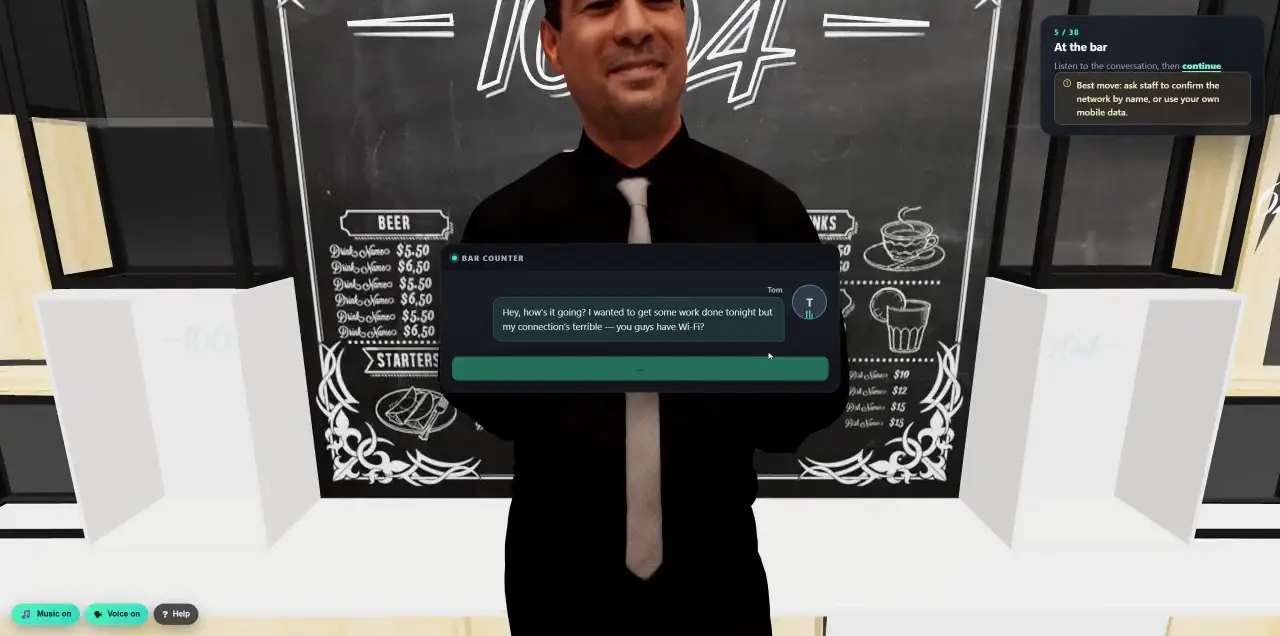
 Walk into a 3D lesson.Watch a learner go through the bar scenario, step by step.
- Platform
- Adaptive Risk Campaigns
One adaptive campaign. Every employee gets their own journey.
Set the goal and the guardrails once. Cyberfrog then adapts simulations, lessons and reinforcement to each person’s role, language, skills and behaviour, continuously, and shows you exactly why it did what it did.
- Individual paths, one campaign
- Driven by real behaviour
- Explainable risk
- Autopilot or your own rules
Three employees. Three different journeys.
One campaign adapts its content, simulation type, language, difficulty and follow-up to each person, based on what they actually do.
- Anna · Finance · GermanyFalls for an invoice scam
Gets an invoice simulation in German and enters her password. An immediate micro-lesson on credential phishing follows; when she fails the quiz, different material comes later, and a follow-up simulation checks that it stuck.
- Ben · Engineering · UKSpots it and reports it
Reports a fake developer-platform notice with the report button. He earns recognition in the portal, his risk goes down, and his next simulation is a more sophisticated developer scenario.
- Chloé · HR · FranceMisses a deadline
Gets GDPR training in French, misses the reminder date and receives a friendly, factual reminder. Her compliance status shows overdue until she completes it, then her journey simply continues.
Goals and guardrails, not flowcharts.
You define what you want to achieve and what Cyberfrog may do. You do not draw every possible path for every employee: Cyberfrog builds and runs them.
- Objective
Reduce human risk, improve phishing resilience, meet a compliance goal or strengthen one skill, such as payment-fraud detection.
- Audience
The whole organisation or selected teams. Department, role, country and language are picked up automatically.
- Starting point
Training first, simulation first, or a baseline assessment.
- Adaptation
Autopilot, or your own rules for follow-ups, difficulty, remediation and reminders.
- Guardrails
Frequency caps, working hours, escalation permissions and exclusions, so nobody is overloaded.
- Review and start
Approve the programme. It can run without an end date: new employees join automatically, and changes of role or language shape what comes next.
Every meaningful event becomes a signal.
Cyberfrog records what people do across simulations, learning, policies and reporting, and decides whether a new action is useful, or whether doing nothing is better.
- Clicked
- Submitted
- Reported
- Avoided
- Quiz passed or failed
- Policy acknowledged
- Deadline missed
- New role or language
- Trustworthy
- Only attributable behaviour counts: clicks from mail scanners and email opens do not raise anyone’s risk.
- Fair
- A missed deadline is evidence about compliance, not proof that someone falls for phishing, and is treated that way.
- Later
- Identity, DLP and SOC signals can be added through integrations, where events can be attributed reliably.
Not a points tally. A credible risk picture.
Human risk is not calculated by adding penalties and subtracting courses. Cyberfrog keeps behaviour, exposure and learning apart, and shows every component with its evidence.
- Behaviour
- What people actually did in simulations and assessments, weighted by difficulty and how recent it is.
- Exposure
- How much damage a successful attack on this role could do: privileges, sensitive data, threats it faces.
- Learning
- Training, demonstrated knowledge, policy acknowledgements and deadlines.
- Honest
- New employees without enough evidence show “insufficient evidence”, not a reassuring low score.
- One profile
One risk history per person across every campaign, never contradictory scores.
- Versioned
A deterministic, configurable model; every change of the model is versioned.
- Explained
Which events, which weights, which version moved the score.
- Not bought
Portal points reward good behaviour, but never buy a lower risk score.
The right next step, automatically.
Cyberfrog picks useful interventions, not an endless stream of reminders. Start with Autopilot’s tested defaults, add your own rules, or target a group by hand at any moment.
- Failed a simulation
- An immediate micro-lesson and a later retest on the same skill.
- Failed a quiz twice
- Different material for the same weakness.
- Reported three in a row
- Higher difficulty within your limits; consistently strong people get fewer simulations.
- Training overdue
- A localised, factual reminder, then compliance status and any escalation you permitted.
- Entered a high-risk group
- More frequent checks, always within contact caps.
Why it changed, what came next, and whether it helped.
Every employee has a Risk Journey: a timeline of events, interventions and outcomes. Authorised admins can pause, reschedule, exclude, replace an activity or correct a wrong event.
- Audited
- Every manual change is logged, and corrected scores are recalculated.
- Retention checks
- Short reassessments weeks after a lesson show whether learning lasted.
- Effect measured
- Improvement is proven by later behaviour, not by course completion alone.
Built to be fair to employees.
Individual behavioural records need trust. Governance is part of the feature, not an afterthought.
- Transparent
Clear explanations for employees of what is collected, how risk is measured and what happens automatically.
- Proportionate
Collection limited to the purpose, with retention periods you configure.
- Private by role
Risk classifications only for authorised staff; reminders to employees stay factual.
- Correctable
Wrong events can be challenged and corrected, and scores are recalculated.
- Human approval
Sensitive escalations and actions affecting other systems wait for a person to approve.
- Separated
Each customer’s histories, rules and actions stay in its own workspace, also for MSPs.
The execution layer of human risk.
- MeasureHuman Risk and analytics
The intelligence layer: scores, trends, dashboards and reports across all campaigns.
See Human Risk - PlanAnnual programmes
A planned year for everyone; adaptive campaigns add a personal path on top.
See programmes - ReportPhishing reporting
Verified reports are the strongest positive signal an adaptive campaign gets.
See reporting
One campaign that keeps getting smarter.
In a 30-minute demo we set the goal and guardrails together and walk through the first journeys.