
 Walk into a 3D lesson.Watch a learner go through the bar scenario, step by step.
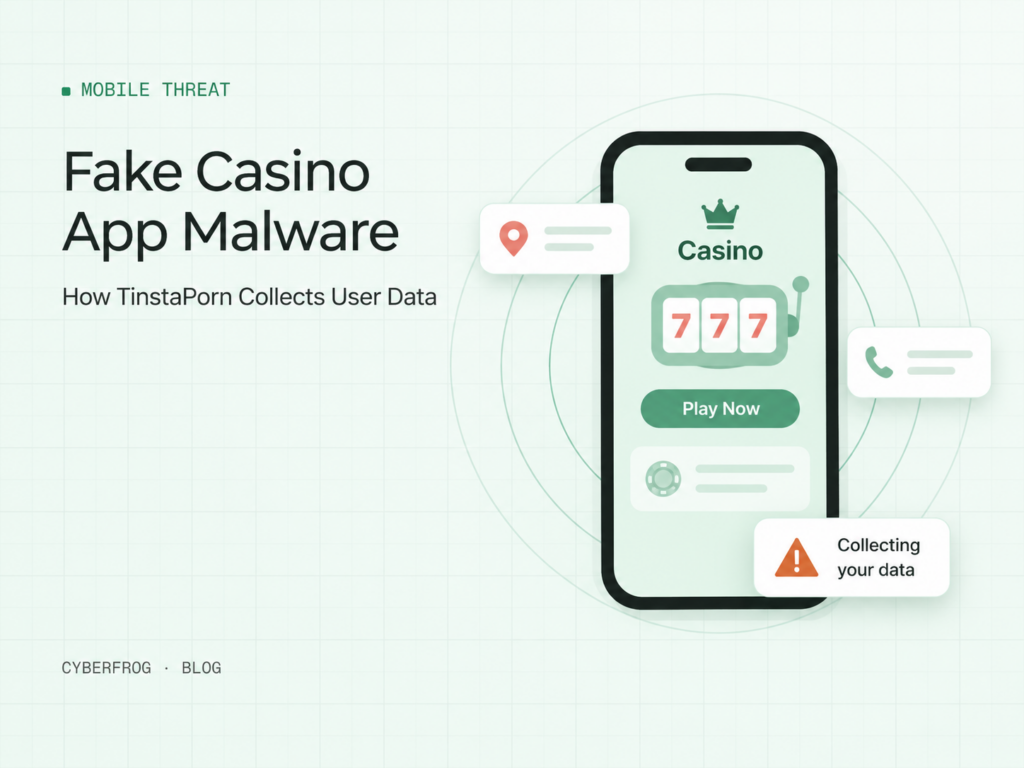
Fake casino app malware is emerging as a serious mobile security concern after researchers identified TinstaPorn, a malicious Android application disguised as a legitimate gambling platform. The app collects phone numbers, precise location information, and device identifiers while encouraging users to participate in manipulated casino games. The discovery highlights why security awareness training for employees must extend beyond phishing emails to include mobile applications, privacy risks, and deceptive digital services.
Disclosed by FortiGuard Labs in November 2026, TinstaPorn demonstrates how attackers can combine an apparently functional entertainment application with hidden data collection.
For organizations allowing personal smartphones to access corporate resources, understanding this threat can help employees recognize suspicious apps before installing them.
What Is TinstaPorn Fake Casino App Malware?
TinstaPorn is a malicious Android application identified by FortiGuard Labs as Android/TinstaPorn.A!tr.
Despite its misleading name, the application is not associated with adult content. Instead, it presents itself as an online version of a well-known Macau casino.
Users encounter familiar gambling activities, including roulette and slot machines, alongside promotional mechanisms encouraging additional spending.
Researchers identified several concerning characteristics:
- Casino games with mathematical odds favoring the operators.
- Collection of telephone numbers and location information.
- Transmission of device identification data.
- Multiple servers supporting the application.
- Financial incentives involving VIP recharges, rebates, and referrals.
- An implementation built using Google’s Flutter framework.
The operation combines financial exploitation with unauthorized collection of personal information.
Importantly, the public research does not establish how many people installed the application or confirm a particular worldwide distribution campaign.
How TinstaPorn Android Malware Collects Personal Data
The application operates through a relatively sophisticated infrastructure rather than relying on a single backend server.
Its functionality combines legitimate-looking gambling interfaces with services that register devices, distribute configuration information, and exchange user data.
Phone number collection
Researchers observed communication with backend endpoints responsible for associating telephone numbers with application accounts.
A phone number can serve as a persistent personal identifier.
When combined with other information, it may help operators connect different activities to a particular individual.
Precise geolocation tracking
TinstaPorn collects geographical coordinates, including latitude, longitude, location accuracy, and timestamps.
These details may reveal where a device was located when the information was transmitted.
Repeated location collection can create significant privacy risks, particularly when associated with identifiable accounts.
Device information collection
The application also transmits technical information that can help distinguish one Android device from another.
Device fingerprinting can involve combining multiple characteristics to recognize returning devices.
For employees using personal smartphones for both work and private activities, this kind of monitoring creates additional concerns about personal privacy.
However, the researchers did not establish that TinstaPorn directly stole corporate credentials or accessed enterprise applications.
Why Flutter Makes This Android Malware Different
Flutter is an open-source application development framework maintained by Google.
Developers use it to create applications for multiple operating systems from a shared codebase.
The framework itself is legitimate and widely used.
However, its compiled application structure can complicate reverse engineering when researchers investigate malicious software.
Traditional Android analysis techniques may not reveal Flutter application logic as easily as expected.
FortiGuard Labs highlighted improvements in specialist analysis tools, including r2flutter, Bytecode Studio, and AI-assisted reverse engineering.
The original FortiGuard Labs investigation of TinstaPorn explains how researchers examined the application’s behavior and supporting infrastructure.
The broader lesson is that an application can look polished and function normally while performing unwanted activities behind the scenes.
How the Fake Casino App Communicates With Its Servers
TinstaPorn uses multiple backend services to maintain its operation.
Rather than connecting directly to one permanent server, the application follows several stages.
Configuration retrieval
The application initially contacts configuration sources containing addresses for registration servers.
Researchers identified configuration files hosted through services including GitHub and Gitee.
These files provided server information rather than executable malware.
Device registration
After obtaining its configuration, the application communicates with registration servers and exchanges identifying information.
This process helps the platform associate devices with its backend systems.
Game server selection
Additional services provide the addresses of available gambling servers.
The application can store configuration information locally and test server responsiveness before selecting a connection.
Hardcoded alternatives can also help maintain connectivity when some infrastructure becomes unavailable.
Protected communications
Researchers observed AES encryption and HMAC-SHA256 signatures in communications.
However, encryption alone does not make an application trustworthy.
In this case, the key material’s distribution reduced some of the protection these mechanisms would otherwise provide.
Why Fake Casino App Malware Is a Human Security Risk
The primary challenge is not that users must understand sophisticated malware.
It is that ordinary application-installation decisions can expose personal information.
Cybercriminals often exploit trust through convincing interfaces, familiar branding, and attractive offers.
A gambling application may appear credible because it displays functional games, account balances, or professional-looking promotional content.
Yet none of these elements proves that its operator is legitimate.
Train people for the attacks they actually face.
Build stronger habits with phishing, vishing, smishing, deepfake and immersive 3D simulations employees remember.
Employees should learn to evaluate applications based on their origin, permissions, privacy practices, and actual necessity.
This extends the security-awareness challenge beyond the corporate inbox.
A useful comparison is Cyberfrog’s article on RemControl Android malware and mobile security awareness, which discusses another campaign involving deceptive mobile applications.
The two threats have different documented capabilities and should not be treated as technically identical.
Warning Signs of Malicious Android Applications
Recognizing suspicious applications requires attention to several indicators.
| Warning sign | Why it matters |
|---|---|
| Unknown download source | The application may bypass established review processes |
| Excessive permissions | Access requests may exceed the application’s legitimate needs |
| Unclear developer identity | Users cannot easily assess accountability |
| Unrealistic rewards | Attractive offers may encourage risky behavior |
| Unnecessary personal data | Collected information may be unrelated to the service |
| Suspicious updates | Unexpected downloads may introduce additional risks |
These signals should be evaluated together.
For example, requesting location access is not automatically malicious. Some legitimate applications need location information.
The important question is whether the request is necessary, transparent, and appropriate for the functionality provided.
Employees should also understand that an application appearing in a familiar interface does not automatically establish its safety.
How Security Awareness Training Can Reduce Mobile Risks
Organizations can use the TinstaPorn case to teach practical decisions about mobile application security.
A useful awareness exercise might present employees with several fictional application listings and ask them to identify suspicious permissions, questionable publishers, and misleading promotional claims.
The exercise should focus on behaviors employees can apply immediately.
For example:
- Verify who developed the application.
- Examine permissions before installation.
- Avoid downloading APK files from untrusted sources.
- Question applications requesting unnecessary personal details.
- Report suspicious applications installed on work-connected devices.
Cyberfrog supports interactive cybersecurity training and employee learning through educational content, realistic scenarios, and security simulations.
Organizations can use these capabilities to reinforce safe mobile behavior without exposing employees to actual malicious software.
External threat monitoring may also complement internal investigations. For example, dark web monitoring can help security teams investigate certain exposed credentials or leaked information, although it does not directly identify every malicious Android application.
Best Practices for Protecting Corporate and Personal Devices
Mobile security requires a combination of employee education and technical controls.
Organizations should establish clear policies governing which applications employees can install on corporate devices.
For personally owned devices, policies should distinguish legitimate business-security requirements from unnecessary access to private information.
Recommended controls include:
- Keeping Android and installed applications updated.
- Enabling Google Play Protect.
- Using approved application sources.
- Applying mobile device management where appropriate.
- Separating corporate information from personal applications.
- Reviewing application permissions periodically.
- Reporting suspected malware promptly.
Security teams should also ensure employees understand how to request assistance without fearing punishment for reporting a potential mistake.
Early reporting may allow an organization to investigate suspicious activity before additional systems are affected.
What to Do If TinstaPorn Is Installed
Anyone who discovers TinstaPorn on their Android device should treat it as potentially compromised by the application.
The first step is to stop using the app and disconnect it from any linked accounts where practical.
Next, users should remove the application, inspect installed software, review permissions, and perform a mobile security scan using trusted tools.
If the device accesses corporate applications, the employee should notify the appropriate IT or security team.
Organizations may need to review authentication activity and determine whether additional security measures are appropriate.
Users should also consider whether their phone number and location information may already have been disclosed.
Removing the application cannot reverse information previously transmitted to its operators.
Frequently Asked Questions
What is TinstaPorn Android malware?
TinstaPorn is a malicious Android gambling application analyzed by FortiGuard Labs.
It impersonates a legitimate-looking Macau casino platform while collecting telephone numbers, device information, and precise geolocation data.
Researchers also identified gambling mechanics designed to favor the operators financially.
Does TinstaPorn steal banking credentials?
The published research confirms collection of phone numbers, location information, and device-related data.
It does not establish that TinstaPorn steals banking passwords or corporate authentication credentials.
Those capabilities should not be attributed to this specific malware without additional technical evidence.
How can users recognize fake casino app malware?
Users should examine the application’s publisher, installation source, permissions, privacy information, and promotional claims.
Unexpected requests for precise location or unnecessary personal data deserve additional scrutiny.
No single indicator proves an application is malicious, so multiple warning signs should be evaluated together.
Can security awareness training prevent mobile malware?
Training can help employees recognize suspicious applications and make safer installation decisions.
However, awareness alone cannot eliminate mobile malware.
Effective protection also requires updated devices, application controls, endpoint security, appropriate permissions, and clear incident-reporting procedures.
Build Stronger Mobile Security Awareness With Cyberfrog
TinstaPorn demonstrates how malicious applications can exploit familiar digital experiences while collecting sensitive information.
Organizations should prepare employees to recognize deceptive apps, evaluate permissions, and report suspicious behavior across personal and corporate devices.
Cyberfrog helps security teams translate real-world threats into practical learning experiences that reinforce everyday security decisions.
Explore the platform and request a Cyberfrog demo to discover how targeted awareness training can strengthen mobile security habits and reduce preventable human cyber risks.
Sources
Make awareness training feel real.
Phishing, vishing, smishing, deepfake and 3D simulations with AI content and unified reporting.