
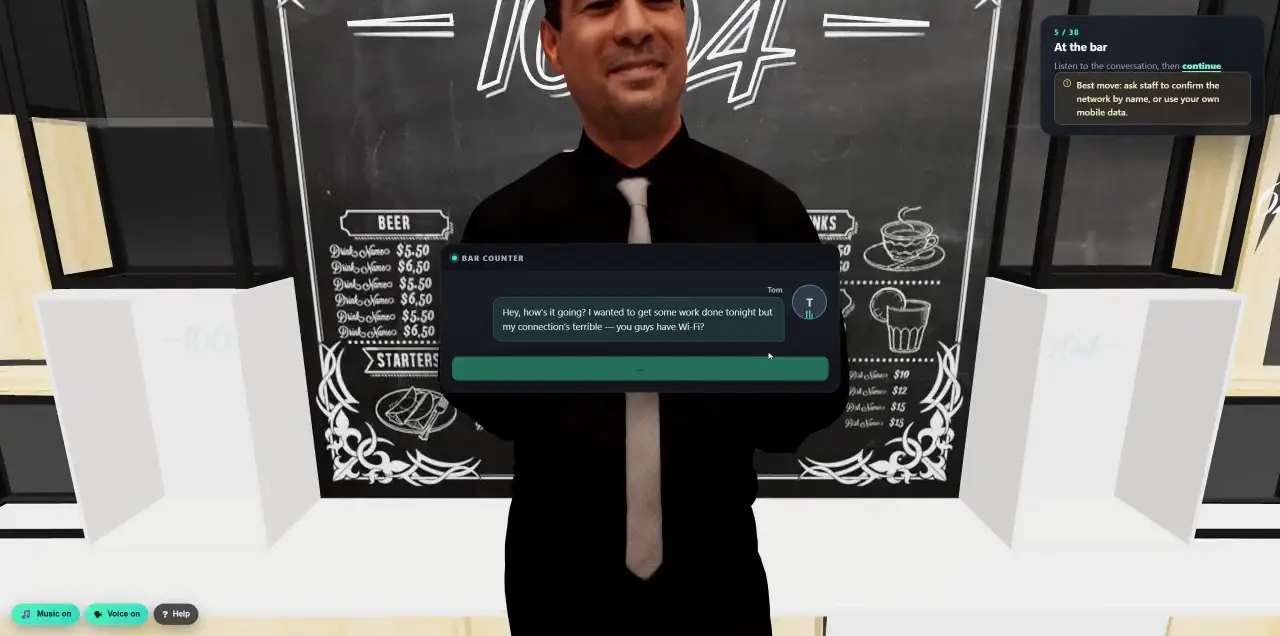
 Walk into a 3D lesson.Watch a learner go through the bar scenario, step by step.
On October 8, 2026, British fashion retailer ASOS confirmed that attackers had gained unauthorized access to customer information following a social engineering attack.
Rather than exploiting a publicly disclosed software vulnerability, the attackers impersonated a trusted contact to obtain an employee’s login credentials. Those credentials were subsequently used to access third-party platforms used by the company.
According to ASOS, the exposed information included customers’ names, contact details and certain non-personal account-related information. The company stated that payment card details and account passwords were not compromised.
This incident raises an uncomfortable question for every business:
What happens when an attacker knows exactly how to make an employee trust them?
How the ASOS Attack Unfolded
The reported incident illustrates a familiar but highly effective attack pattern.
1. The attacker impersonated someone trustworthy
The intrusion began when an unauthorized individual posed as a trusted contact.
The goal was not necessarily to look technically sophisticated. It was to appear legitimate enough that an employee would provide access information.
Social engineering exploits normal workplace behavior: responding quickly, helping colleagues and trusting familiar relationships.
2. Employee credentials became the entry point
Once the attackers obtained valid login credentials, they were able to access certain external platforms.
This matters because many organizations rely on interconnected SaaS applications for marketing, communications, customer management and support.
An attacker does not always need direct access to a company’s core infrastructure to obtain valuable information.
3. Customers received unauthorized notifications
On October 6, some ASOS customers received unauthorized notifications through the retailer’s mobile application, including messages making claims about a breach and directing attention toward an external communication channel.
ASOS subsequently warned customers to disregard the notifications and avoid engaging with the links.
The attack therefore demonstrated two risks at once: unauthorized access to customer data and the misuse of a communication channel that customers normally trust.
Why This Breach Matters Beyond Retail
ASOS is not an isolated example of social engineering.
Employees in finance, healthcare, technology, logistics and professional services all interact with vendors, partners and support teams.
Attackers can exploit those relationships through:
-
Fake IT support calls requesting login details.
-
Messages impersonating trusted suppliers.
-
Urgent requests to verify accounts.
-
Fraudulent multi-factor authentication prompts.
-
Requests to move conversations to unfamiliar platforms.
The most effective attacks are not always the most dramatic. Often, they blend into ordinary business communication.
Three Warning Signs Employees Should Recognize
Unexpected requests for credentials
A caller or message claiming to be from IT support should never be treated as trustworthy solely because it uses a familiar company name.
Employees should verify the person’s identity through an established internal channel.
Pressure to act immediately
Attackers frequently create artificial urgency.
Messages claiming that an account will be disabled or that a critical incident requires immediate action can encourage employees to bypass normal procedures.
A change in communication channel
A familiar business contact suddenly requesting a conversation through an unfamiliar chat application or an unverified website should trigger additional scrutiny.
Train people for the attacks they actually face.
Build stronger habits with phishing, vishing, smishing, deepfake and immersive 3D simulations employees remember.
This does not prove malicious intent, but it creates a clear reason to verify the request.
What Security Awareness Training Should Teach After ASOS
Traditional awareness courses often explain phishing through generic examples involving suspicious spelling and obvious fake websites.
Real attacks are frequently more convincing.
Employees need opportunities to practice making decisions in realistic situations.
For example, an organization could simulate:
Scenario A: The trusted vendor
An employee receives a message from someone claiming to represent an existing supplier. The message requests access verification before a scheduled integration.
Scenario B: The urgent IT call
A caller claims that an employee’s account has been compromised and asks them to disclose a security code.
Scenario C: The familiar platform
A notification appears to originate from a legitimate business application but instructs the user to visit an unexpected external website.
These exercises should teach verification, reporting and appropriate escalation rather than simply measuring whether somebody clicks a link.
Five Practical Actions for Organizations
-
Train employees to verify unexpected requests involving credentials, access privileges or authentication codes.
-
Use phishing-resistant authentication wherever possible, and restrict access to sensitive third-party systems.
-
Establish clear procedures for reporting suspicious calls, messages and application notifications.
-
Review the permissions granted to external business platforms.
-
Measure security behavior over time, particularly early reporting and the correct handling of suspicious requests.
Security awareness is most effective when supported by technical controls and a culture where employees feel comfortable reporting potential mistakes.
The Cyberfrog Perspective: Build Recognition Through Experience
The ASOS incident demonstrates that attackers can transform ordinary workplace trust into an attack vector.
Organizations cannot eliminate human interaction, and they should not expect employees to become cybersecurity experts overnight.
What they can do is help people recognize manipulation before it leads to a security incident.
Cyberfrog focuses on practical, realistic security awareness experiences that help employees develop safer habits around phishing, impersonation and suspicious requests.
The objective is not simply to complete another training course. It is to build the confidence to challenge an unusual request, even when it appears to come from someone familiar.
Conclusion
The ASOS data breach is a reminder that a familiar name or trusted communication channel is not proof of authenticity.
One successful impersonation can expose information across interconnected business systems.
The most valuable security habit may be the simplest: verify before you trust.
Turn Real-World Attacks Into Better Security Habits
Help your employees recognize social engineering before a convincing message becomes a costly incident.
Sources
- Amp bleepingcomputer.com
Make awareness training feel real.
Phishing, vishing, smishing, deepfake and 3D simulations with AI content and unified reporting.