
 Walk into a 3D lesson.Watch a learner go through the bar scenario, step by step.
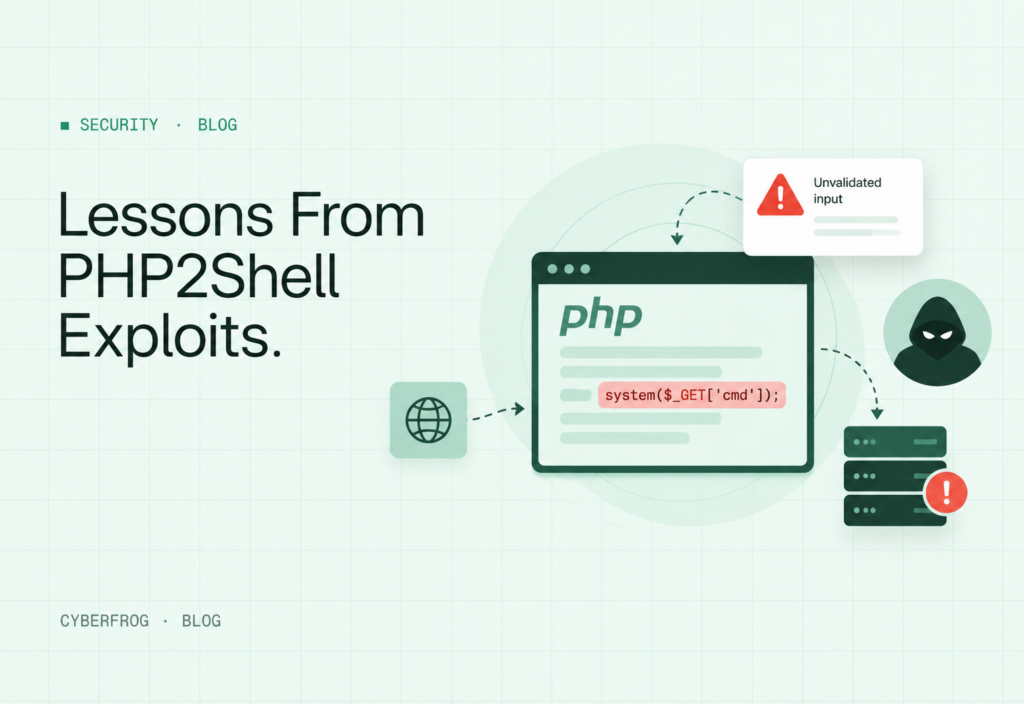
Human Risk Management helps organizations address the people-related risks that emerge during a technical security incident. The PHP2Shell vulnerabilities demonstrate why rapid patching, accurate security communication, and employee awareness must work together. On October 26, 2026, BleepingComputer reported confirmed exploitation of two critical PHP remote code execution (RCE) vulnerabilities. The development creates an opportunity for organizations to review both their technical defenses and their response to urgent security advisories.
The PHP2Shell incident is primarily a software security issue, not a phishing attack. However, the pressure to investigate and remediate vulnerabilities can create opportunities for social engineering, making security awareness a useful supporting layer in incident readiness.
What Happened With the PHP2Shell Vulnerabilities?
PHP2Shell refers to two critical remote code execution vulnerabilities tracked as CVE-2026-109618 and CVE-2026-109619. These flaws can allow unauthenticated attackers to execute code on vulnerable PHP installations, potentially compromising the integrity and availability of affected systems.
According to BleepingComputer’s report on successful PHP2Shell exploitation, researchers observed evidence of successful remote code execution against an Apache mod_php installation running PHP 8.4.26. The evidence came from a honeypot operated by a Perplexity researcher and was corroborated by an Expel threat researcher.
Earlier activity had included scanning, fingerprinting, and unsuccessful exploitation attempts. The later findings changed the assessment: successful exploitation had been demonstrated, although the evidence did not establish widespread compromise or prove that every PHP configuration was equally susceptible.
The PHP development team released security updates on October 21, 2026. On October 27, CISA added both vulnerabilities to its Known Exploited Vulnerabilities (KEV) Catalog, reinforcing the need for organizations to prioritize remediation.
Why PHP2Shell Requires Immediate Technical Action
Security awareness cannot repair a software vulnerability. The first priority is to identify affected PHP installations, apply the appropriate security updates, and verify that remediation is complete.
The PHP security team released fixed versions including PHP 8.5.12, 8.4.27, 8.3.36, and 8.2.35. Organizations should consult the official PHP security advisory and applicable vendor guidance to determine the correct update for each environment. Products that bundle PHP may require separate vendor updates.
Security and infrastructure teams should:
- Inventory PHP applications, web servers, containers, appliances, and embedded deployments.
- Prioritize internet-facing systems and environments using Apache mod_php.
- Apply supported security updates or vendor-provided backports.
- Investigate suspicious server activity and preserve relevant logs.
- Verify remediation and document any remaining exposure.
A separate vulnerability, CVE-2026-115560, was also disclosed in October. The PHP team initially recommended disabling session upload progress as a temporary mitigation for this distinct issue. Organizations should track its guidance separately rather than confusing it with the two patched PHP2Shell vulnerabilities.
GitHub
How Human Risk Management Supports Vulnerability Response
Human Risk Management examines how people, processes, and security decisions influence organizational risk. During a vulnerability disclosure, it can help teams establish clear responsibilities, verify security instructions, escalate suspicious activity, and coordinate remediation.
A technically sound response can still encounter organizational obstacles. Administrators may overlook an asset, application owners may delay an update, or employees may receive conflicting instructions about what to do next.
These challenges are not necessarily evidence of careless behavior. They can indicate unclear ownership, insufficient training, poor communication, or procedures that have not been tested.
An effective response process should clarify:
- Who identifies affected assets and confirms their versions.
- Who approves and implements security changes.
- How employees verify unexpected requests involving updates or credentials.
- Where suspicious communications and potential exploitation are reported.
- Who confirms that remediation is complete.
Security teams should communicate responsibilities in language appropriate to each audience. Developers need precise technical guidance, while other employees need to understand what to report, which instructions to trust, and when to contact IT.
How Attackers Can Exploit Urgent Security Advisories
There is no evidence in the cited PHP2Shell reporting that phishing or social engineering caused the exploitation. Nevertheless, vulnerability announcements can provide a believable pretext for unrelated fraud.
An attacker might impersonate a software vendor, hosting provider, or internal IT administrator and claim that an employee must install an emergency update. Another message might direct a developer to an unfamiliar download page or ask an administrator to disclose credentials to complete a supposed security check.
These scenarios exploit urgency and authority. During an incident, employees may expect unusual communications, making it especially important to distinguish legitimate procedures from unverified requests.
Training should teach employees to recognize warning signs such as:
- Unexpected links to software updates or diagnostic tools.
- Requests for passwords, authentication codes, or remote access.
- Instructions to disable security controls or bypass approval procedures.
- Unusual requests that cannot be verified through established channels.
- Pressure to act immediately without consulting the responsible team.
Employees should access official vendor advisories directly, confirm unusual requests independently, and report suspicious messages. Awareness training can reinforce these behaviors, but it cannot replace technical patching, access controls, or incident response.
How Security Awareness Training Can Reinforce Incident Readiness
Security awareness training becomes more useful when it reflects situations employees may actually encounter. Instead of presenting vulnerability management as an abstract technical subject, organizations can use current events to explain safe decision-making and reporting.
For example, a training exercise could ask employees to evaluate an unexpected message announcing an emergency software update. Learners would practise verifying the sender, checking the request through an approved channel, and reporting the message if its legitimacy could not be established.
Administrators and developers may need additional role-specific learning covering advisory verification, change approval, secure deployment procedures, and escalation requirements.
Cyberfrog’s security awareness training library includes interactive lessons, video training, web courses, and other awareness materials. Organizations can use relevant learning formats to reinforce security procedures while technical teams handle vulnerability assessment and remediation.
How Phishing Simulations Help Employees Practise Safe Decisions
Phishing simulations allow organizations to evaluate employee responses to controlled social-engineering scenarios. When designed around an actual organizational risk, these exercises can help employees practise recognizing suspicious requests and using reporting channels.
Train people for the attacks they actually face.
Build stronger habits with phishing, vishing, smishing, deepfake and immersive 3D simulations employees remember.
A PHP2Shell-inspired simulation could present a hypothetical emergency-update message and assess whether participants verify the request rather than automatically trusting its urgency. The exercise should be authorized, safe, and followed by constructive feedback.
A simulated interaction does not prove that an employee would be compromised in a real attack. Equally, avoiding a simulated phishing message does not establish that the employee can recognize every future threat.
The purpose is to identify learning opportunities and improve behavior over time, not to assign blame.
Cyberfrog’s AI-powered security awareness and phishing simulation platform combines awareness training with controlled attack simulations. These approaches can support a broader security program by helping employees practise decisions while technical teams maintain responsibility for patching, monitoring, and incident response.
How Continuous Security Awareness Improves Preparedness
Continuous Security Awareness reinforces security behaviors throughout the year rather than relying exclusively on annual training. Lessons can be updated when relevant incidents, changing attack methods, or recurring reporting problems reveal a need for additional guidance.
AI-Generated Security Awareness Content can also help teams turn reviewed security advisories into learning materials more efficiently. Human oversight remains necessary to confirm technical accuracy, avoid overstating incident details, and ensure that hypothetical examples are not presented as real attacks.
A practical program should distinguish between several measures:
| Measure | What it indicates |
| Training completion | Whether assigned learning was completed |
| Knowledge assessments | Whether participants understand key procedures |
| Simulation results | How participants responded to controlled scenarios |
| Reporting behavior | Whether suspicious activity is reported appropriately |
| Improvement over time | Whether follow-up learning supports better decisions |
| Remediation status | Whether technical security actions have been completed |
No single measure proves that human risk has been eliminated. Likewise, training records cannot establish whether a PHP server has been patched.
Organizations should use these measures together while maintaining separate technical vulnerability-management and incident-response processes.
Where URL Analysis API Fits Into Security Awareness
A URL analysis API can support workflows that assess suspicious web addresses encountered in emails, messages, or security investigations. Depending on the service, automated analysis may help security teams prioritize potentially harmful links for further review.
This capability is relevant to the social-engineering risks surrounding urgent vulnerability announcements, but it does not mitigate PHP2Shell itself. A URL assessment cannot replace PHP updates, server configuration reviews, or investigation of suspicious execution.
Organizations should verify the capabilities and limitations of any URL analysis service before integrating it into security workflows. Employees must still know how to report suspicious messages, while technical controls and security teams handle the underlying investigation.
Frequently Asked Questions
Does PHP2Shell prove that every PHP website was compromised?
No. Researchers confirmed successful exploitation in a specific environment, but this does not establish widespread compromise or prove that every PHP installation was successfully exploited. Organizations should identify their PHP deployments, apply the relevant security updates, and investigate available evidence rather than assuming either universal compromise or universal safety.
Can security awareness training prevent remote code execution?
No. Remote code execution vulnerabilities require technical remediation, including security updates and appropriate configuration management. Awareness training can help employees recognize fraudulent update instructions, verify unusual requests, and report suspicious activity. It complements technical security measures rather than replacing them.
What should employees do when they receive an emergency security-update message?
Employees should verify the request through official vendor documentation or established internal channels. They should avoid opening unexpected downloads, disclosing credentials, or bypassing approval procedures. If a message appears suspicious, they should report it through the organization’s designated process and wait for confirmation before taking action.
How can organizations measure whether human risk is improving?
Organizations can assess training completion, knowledge, reporting behavior, simulation outcomes, and changes in behavior over time. Results should be interpreted in context, without treating a single click or missed report as proof of permanent high risk. Technical remediation must be measured separately to establish whether affected systems have actually been secured.
Turn Security Awareness Into Practical Incident Readiness
PHP2Shell shows why organizations need both timely technical remediation and employees who understand how to respond safely to urgent security communications. Human Risk Management can strengthen that response through clear procedures, relevant training, and realistic practice.
Explore Cyberfrog to learn how AI-powered security awareness training and phishing simulations can support a more consistent, measurable approach to employee readiness alongside established technical controls.
Disclaimer: Cyberfrogsecurity reports on publicly available threat-intelligence sources. Inclusion of an organization in an article does not imply confirmed compromise. All claims are attributed to external sources unless explicitly verified.
Sources
- Php2shell security flaws now sucessfully exploited in the wild bleepingcomputer.com
- urlscore.ai urlscore.ai
Make awareness training feel real.
Phishing, vishing, smishing, deepfake and 3D simulations with AI content and unified reporting.