

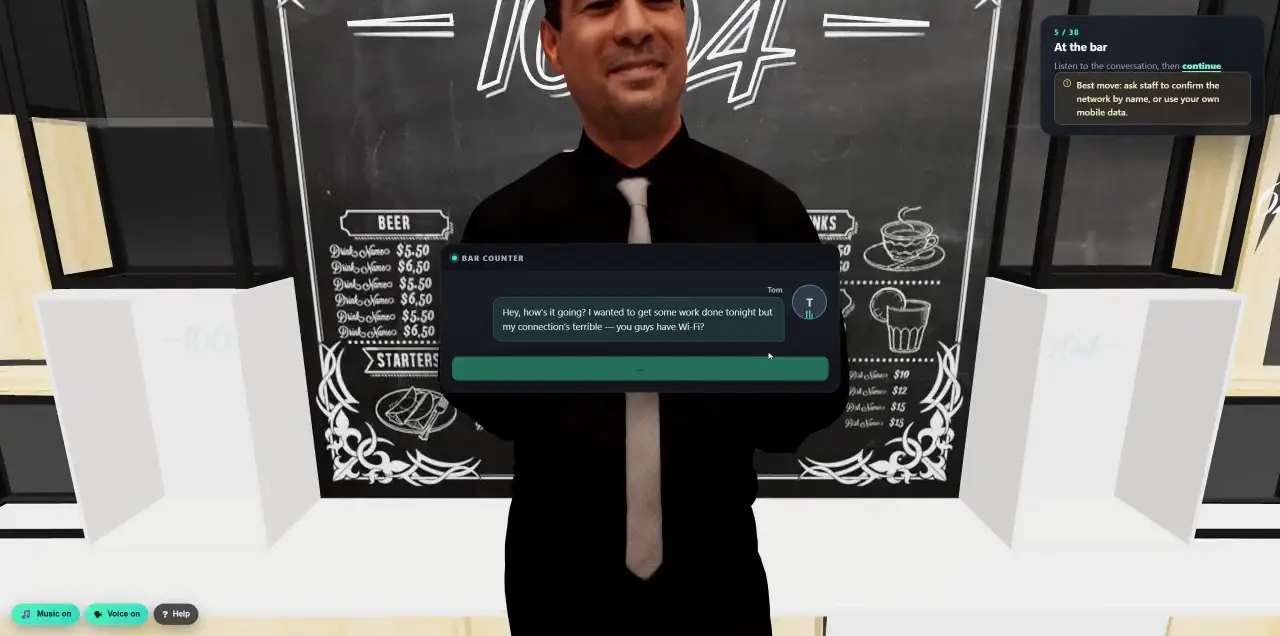
 Walk into a 3D lesson.Watch a learner go through the bar scenario, step by step.
- Industries
- Healthcare
Security awareness training for healthcare, built for every shift.
Clinical staff have minutes, not hours, and attackers know it. Cyberfrog trains doctors, nurses, lab and admin teams with short lessons and realistic simulations that fit between patients, and gives your security team the evidence HIPAA, NIS2 and your auditors ask for.
- Lessons from five minutes
- Phishing, SMS, voice and deepfake
- Exposed staff found in breach data
- HIPAA and NIS2 mapping
Your access to the patient record system will be suspended at 22:00 for the scheduled upgrade unless you re-confirm your credentials. Ward devices without confirmation will be logged out.
Confirm my EHR access- Sender domain is not the hospital's own
- Deadline set for the night shift
- Asks for the password the real IT team never asks for
What attackers send to healthcare teams.
Hospitals run around the clock, depend on systems that must never stop and hold the most valuable personal data there is. That makes people on the ward and at the front desk the shortest way in.
- Ransomware that reaches the ward
ENISA reports ransomware attacks on two German health organisations that led to postponed medical procedures. ENISA Threat Landscape 2025
- Errors and social engineering
In healthcare, system intrusion, miscellaneous errors and social engineering make up 81% of breaches, and the human element is involved in 54%. Verizon DBIR 2026
- Help-desk calls that reset MFA
Groups such as Scattered Spider phone IT help desks posing as employees to get passwords and MFA reset, then follow up with SMS phishing and push bombing. CISA/FBI advisory AA23-320A
- A critical-infrastructure target
The ransomware variants reported most often to the FBI hit critical manufacturing, healthcare and public health, and government facilities hardest. FBI IC3 Report 2025
Training per role, not one course for everyone.
A nurse on a shared workstation, a billing clerk paying suppliers and a CIO answering to the board face different attacks. Cyberfrog gives each group its own path.
- Clinical and ward staff
Shared logins, urgent IT messages and QR codes on posters: five-minute lessons and simulations that fit between patients.
- Front desk and patient services
Callers who pretend to be patients, relatives or insurers, and requests for records over the phone.
- Finance and purchasing
Invoice fraud, changed bank details and fake suppliers of medical equipment.
- IT, management and the board
Help-desk impersonation, MFA reset requests and deepfake calls from executives, plus the management training NIS2 requires.
The same lures, practised safely.
Every simulation looks like what your staff really receive, and every mistake leads straight to a short lesson on exactly that trick.
- EmailEHR login re-confirmation
A fake IT notice before a system upgrade, with a cloned sign-in page.
- VoiceThe help-desk call
An AI caller asks a nurse to read out the code that just arrived on their phone.
- SMSShift-roster change
A text with a link to a fake roster or overtime portal.
- DeepfakeThe medical director on video
An urgent video request to approve an unusual payment or data export.
Find the staff attackers already know.
Healthcare credentials leak through personal breaches and infostealer malware on home computers. Cyberfrog checks your domain against Darknetsearch's breach and stealer-log data and shows which employees are exposed.
Exposed people get a personal notice and a lesson on exactly how their data leaked, and can be placed in a targeted simulation first. Passwords are only shown as much as your privacy settings allow.
What the rules ask of healthcare.
Most healthcare organisations answer to several frameworks at once. Cyberfrog maps your programme's topics to their awareness controls and keeps completion records per person.
| Rule | What it asks for | How Cyberfrog helps |
|---|---|---|
| HIPAA Security Rule, 45 CFR 164.308(a)(5)Mapped in Cyberfrog | A security awareness and training programme for all members of the workforce, including management. | Programme mapped to the HIPAA Security Rule, with completion and simulation records per person. |
| NIS2 Directive, Art. 20 and 21 (health sector, Annex I)Mapped in Cyberfrog | Training for management bodies and basic cyber hygiene and cybersecurity training as a risk-management measure. | NIS2 mapping, management lessons and evidence reports. |
| GDPR, Art. 32 and 39 | Appropriate security measures, and staff awareness-raising and training as a task of the data protection officer. | Data-protection topics in the programme and records the DPO can show. |
| Swiss Information Security Act, Art. 74a-74b | Hospitals, licensed labs, pharma and medtech companies must report cyberattacks to the NCSC within 24 hours. | Staff who recognise and report incidents early; the report button feeds your SOC. |
| NHS Data Security and Protection Toolkit | All staff need an appropriate understanding of information governance and cyber security, using role-based training. | Role-based paths for clinical, admin and IT staff. |
Summaries for orientation, not legal advice. Cyberfrog provides training records and coverage reports; it does not certify compliance.
Questions from healthcare teams.
Does HIPAA require security awareness training?
Yes. The HIPAA Security Rule (45 CFR 164.308(a)(5)) requires a security awareness and training programme for all members of the workforce, including management. It does not prescribe a fixed frequency, so most organisations train at onboarding and at least once a year, with reminders in between.
Why are hospitals such a common target?
They cannot afford downtime, they hold highly valuable personal data and many staff share devices across shifts. Ransomware groups use that pressure to demand payment, as ENISA and the FBI describe in their latest reports.
How do you train staff who have no time?
With short lessons of about five minutes, simulations that arrive in the normal working day and an immediate lesson after a mistake, instead of a long annual course.
Can we train for phone calls, not only email?
Yes. Cyberfrog simulates help-desk and caller impersonation with an AI voice that holds a real conversation, plus SMS and deepfake video requests.
Does NIS2 apply to our hospital?
NIS2 lists healthcare providers in Annex I. Whether your organisation is in scope depends on its size and national implementation; if it is, management must be trained and staff training is part of the required risk-management measures.
Related industries.
- IndustryPublic sector
Calls posing as the authorities, AI voice messages from senior officials and ransomware that stops municipal services.
Read more - IndustryFinancial services
Payment-diversion emails, deepfake executives and phone calls that push staff to release a transfer or reset an account.
Read more - IndustryEducation
Phishing in almost every reported breach, and impostors who write in the institution's own name.
Read more
Training that fits between patients.
In a 30-minute demo we show the simulations and lessons for clinical and admin teams, on your own domain.