
 Walk into a 3D lesson.Watch a learner go through the bar scenario, step by step.
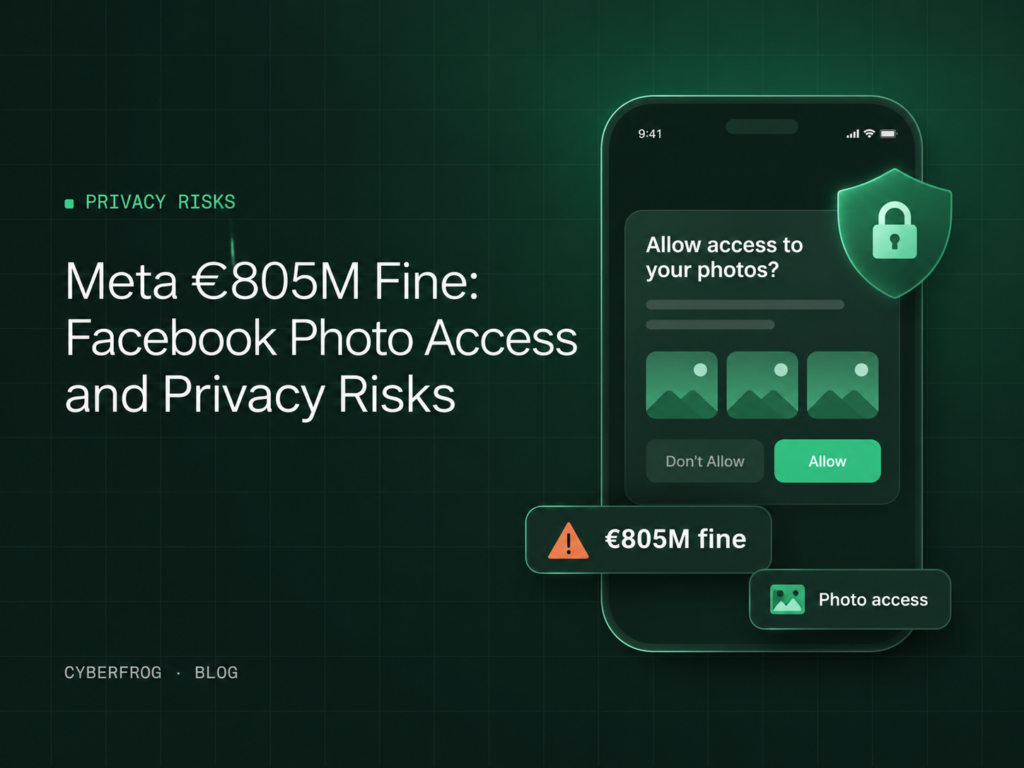
Meta €805M fine over Facebook’s access to Android photo galleries has raised serious questions about mobile application permissions, informed consent, and personal data protection. The decision by Italy’s privacy regulator highlights a security awareness challenge: users often approve broad permissions without fully understanding how their information may be accessed. As discussed in Cyberfrog’s Android malware and mobile security awareness analysis, understanding application permissions is an essential part of protecting personal and corporate information.
On November 14, 2026, Italy’s Data Protection Authority, known as the Garante, announced a €805 million penalty against Meta Platforms Ireland Limited. The authority determined that Facebook’s Android application had accessed users’ photographs, videos, and associated metadata without obtaining sufficiently specific and informed consent.
The case carries important lessons for employees, IT managers, privacy professionals, and organizations developing effective cybersecurity awareness programs.
Why Did Italy Impose the Meta €805M Fine?
The Meta €805M fine concerns a Facebook feature introduced in 2023 that provides suggestions for photographs and videos users might want to publish.
The feature, known as “Get suggestions from gallery when browsing Facebook,” accesses content stored in an Android smartphone’s photo gallery to recommend potential social media posts.
According to the Italian Data Protection Authority’s official decision, Facebook requested gallery access through a general authorization that covered multiple application functions.
The regulator found three principal problems:
-
Insufficiently specific consent: Users were not clearly informed that granting a broad permission also enabled Facebook’s gallery suggestion feature.
-
Default activation: The disputed functionality was enabled by default rather than requiring a separate affirmative choice.
-
Extensive potential access: The authorization could permit access to the device’s entire photo archive without making it clear which information was being used.
The regulator considered these practices incompatible with Article 122 of Italy’s Privacy Code, which implements protections established by the European Union’s ePrivacy Directive.
The investigation began in July 2025 following a complaint from a consumer protection organization in Bolzano.
Italian authorities estimated that approximately 20 million Android users in Italy were affected by the practices under investigation.
The Meta €805M fine reflects the scale of the alleged infringement, its duration, and other factors considered by the regulator.
What Did Facebook’s Android Gallery Feature Actually Do?
Facebook’s gallery suggestion functionality was intended to simplify content sharing.
Instead of requiring users to manually browse their photo library whenever they wanted to publish something, the application could suggest images and videos from their device.
The concern was not simply that Facebook requested permission to access photographs.
Modern applications routinely request access to cameras, microphones, contacts, locations, and local files. Some of these permissions are necessary for legitimate functionality.
The central issue was whether users understood the purpose and extent of the access they were authorizing.
Why a General Permission Is Not Always Informed Consent
Consider a user who allows Facebook to access their photo gallery because they want to upload a profile picture.
That permission may appear reasonable for the immediate action.
However, the user might not expect the same authorization to support a separate feature that examines available gallery content to generate suggestions.
The Italian regulator argued that the distinction should have been clearly explained.
A permission granted for one purpose does not automatically mean that users understand or accept every other potential use.
Did Facebook Access Every Photo?
The regulator explained that a fully granted gallery permission could technically allow extensive access to photographs and videos stored on a device.
That does not establish that Facebook actually examined or transferred every photograph belonging to every affected user.
The distinction between technical access, actual processing, and confirmed data transmission is important.
The authority’s findings concerned the consent mechanism and the extent of access that the application could obtain.
The investigation did not determine whether gallery content had been used to train AI models. Meta denied such use, and the authority indicated that separate inquiries could examine newer cloud-processing functionality.
What Does the Meta €805M Fine Mean for User Privacy?
The Meta €805M fine reinforces a fundamental principle of digital privacy: users should understand what information an application can access and why that access is necessary.
Smartphones routinely contain far more sensitive information than users consciously share online.
A typical photo gallery might include pictures of identity documents, screenshots of financial transactions, workplace materials, family photographs, travel information, or confidential business records.
Even ordinary images may contain metadata revealing timestamps or other contextual information.
For employees who use personal smartphones for work, the implications extend beyond individual privacy.
A photograph taken for legitimate business purposes could contain internal information that should not be exposed to unrelated applications.
This is especially relevant for organizations operating bring-your-own-device policies.
However, the Meta decision should not be interpreted as evidence that Facebook caused a corporate data breach or that attackers obtained the photographs involved.
The case concerns privacy compliance and consent, not a confirmed external cyberattack.
How Employees Can Review Android App Permissions
The most useful response to a mobile privacy incident is to review how applications access personal information.
Employees should develop a habit of checking permissions rather than approving every request automatically.
A practical review can follow five steps.
1. Open Android settings. Navigate to Settings, then Apps or the Permission Manager. The exact wording varies by Android version and manufacturer.
2. Identify sensitive permissions. Review applications with access to photographs, videos, microphones, cameras, contacts, and location data.
3. Evaluate whether access is necessary. Ask whether each application genuinely requires the requested information to perform its intended function.
Train people for the attacks they actually face.
Build stronger habits with phishing, vishing, smishing, deepfake and immersive 3D simulations employees remember.
4. Restrict permissions where possible. Depending on the device and application, users may be able to select specific photographs rather than grant access to the entire gallery.
5. Review permissions regularly. Application updates and changing usage patterns can make previously granted permissions unnecessary.
Employees should also review privacy controls inside individual applications, because operating-system permissions and application-specific preferences are not always the same.
These actions provide additional control, although they cannot independently guarantee that every application processes information appropriately.
Why Mobile Privacy Matters for Corporate Cybersecurity
Mobile security is no longer separate from enterprise cybersecurity.
Employees regularly use smartphones to authenticate into business applications, communicate with colleagues, access cloud services, and handle confidential documents.
This creates several overlapping risks.
An application with unnecessary permissions may expose information beyond what its functionality requires. An employee may accidentally share sensitive images through a personal account. A compromised device may also provide attackers with opportunities to collect credentials or business data.
Organizations therefore need both preventive technical measures and practical employee education.
Mobile device management, application policies, access restrictions, and monitoring can reduce certain risks.
For organizations concerned about sensitive information that has already escaped their controlled environment, dark web monitoring can complement those preventive measures by helping security teams investigate externally exposed information.
However, external monitoring cannot determine whether a smartphone application obtained valid consent or accessed a private gallery without authorization.
These are different security and privacy problems requiring different controls.
How Security Awareness Training Can Reduce Mobile Privacy Risks
The Meta €805M fine provides a useful example for workplace cybersecurity education because it concerns a familiar activity: granting permissions to a popular mobile application.
Effective training should help employees recognize when a request deserves closer attention.
Instead of relying entirely on abstract privacy policies, organizations can develop short practical exercises based on realistic situations.
For example, employees could be shown a fictional application requesting unrestricted photo access even though its primary purpose requires only a single image upload.
They could then decide whether to approve, restrict, or reject the request.
Another exercise might ask participants to identify sensitive information in a photograph before sharing it through a messaging application.
Cyberfrog offers security awareness training for employees through interactive 3D lessons, videos, web courses, quizzes, and other educational formats.
Its training topics include handling data, personal devices, social media, and workplace security policies.
These capabilities can support privacy education, although employee awareness should complement rather than replace technical and organizational controls.
What HR and Security Teams Should Teach
Organizations can incorporate mobile privacy into onboarding and recurring security education.
Important learning objectives include recognizing excessive permissions, handling confidential photographs, understanding consent requests, and knowing when to report privacy concerns.
Training should also distinguish between suspicious behavior and normal application functionality.
Not every request for photo access is malicious, and not every privacy violation represents a cyberattack.
The goal is informed decision-making, not creating unnecessary fear about everyday technology.
What Must Meta Do After the Italian Privacy Decision?
The regulator ordered Meta to implement changes to the disputed functionality.
Within 60 days of the November 14, 2026 decision, the company must request separate, specific consent for the gallery suggestion feature and explain its purpose.
The functionality must also remain disabled by default, including for users who previously granted broader gallery permissions.
Meta must report the initiatives undertaken within 30 days and the measures adopted within 90 days.
If the required changes are not implemented within the specified period, the functionality cannot be activated for users who have not provided valid consent.
Meta has disputed the regulator’s assessment and indicated that it intends to appeal. The company maintains that users must grant device-level permission before the feature operates and can change that authorization in their settings.
Frequently Asked Questions
Why was Meta fined €805 million in Italy?
Italy’s privacy regulator found that Facebook’s Android gallery suggestion feature accessed photographs, videos, and associated metadata without sufficiently specific and informed consent. The authority also identified concerns about broad authorization requests and default activation. The penalty reflected the scale and duration of the infringement and other regulatory considerations.
Does Facebook have access to all my Android photos?
Facebook’s access depends on the permissions granted, application functionality, and device settings. Broad gallery authorization can potentially allow access to extensive photo collections. Users should review both Android application permissions and Facebook’s internal settings to understand and restrict access where appropriate.
Is the Meta privacy fine related to a data breach?
No confirmed external data breach is established by this decision. The investigation concerned Facebook’s access to information stored on Android devices and whether users had provided valid consent. Privacy violations and cybersecurity breaches can overlap, but they are not the same thing.
How can companies teach employees about mobile app privacy?
Organizations can use practical security awareness exercises covering application permissions, sensitive photographs, mobile device policies, and responsible information sharing. Short scenarios and knowledge checks can help employees recognize privacy risks and make better decisions when granting access to personal or business information.
Turn Mobile Privacy Awareness Into Everyday Security Habits
The Meta €805M fine demonstrates why informed consent and mobile privacy deserve attention beyond legal compliance.
Employees need practical skills to recognize unnecessary permissions, protect sensitive information, and understand how everyday applications interact with their devices.
Cyberfrog helps organizations turn real-world cybersecurity and privacy issues into engaging employee learning experiences.
Through interactive training, practical scenarios, and structured awareness programs, businesses can reinforce safer behavior across their workforce.
Explore Cyberfrog’s security awareness platform to discover how practical training can help employees make more informed security decisions.
Sources
- garanteprivacy.it garanteprivacy.it
Make awareness training feel real.
Phishing, vishing, smishing, deepfake and 3D simulations with AI content and unified reporting.