
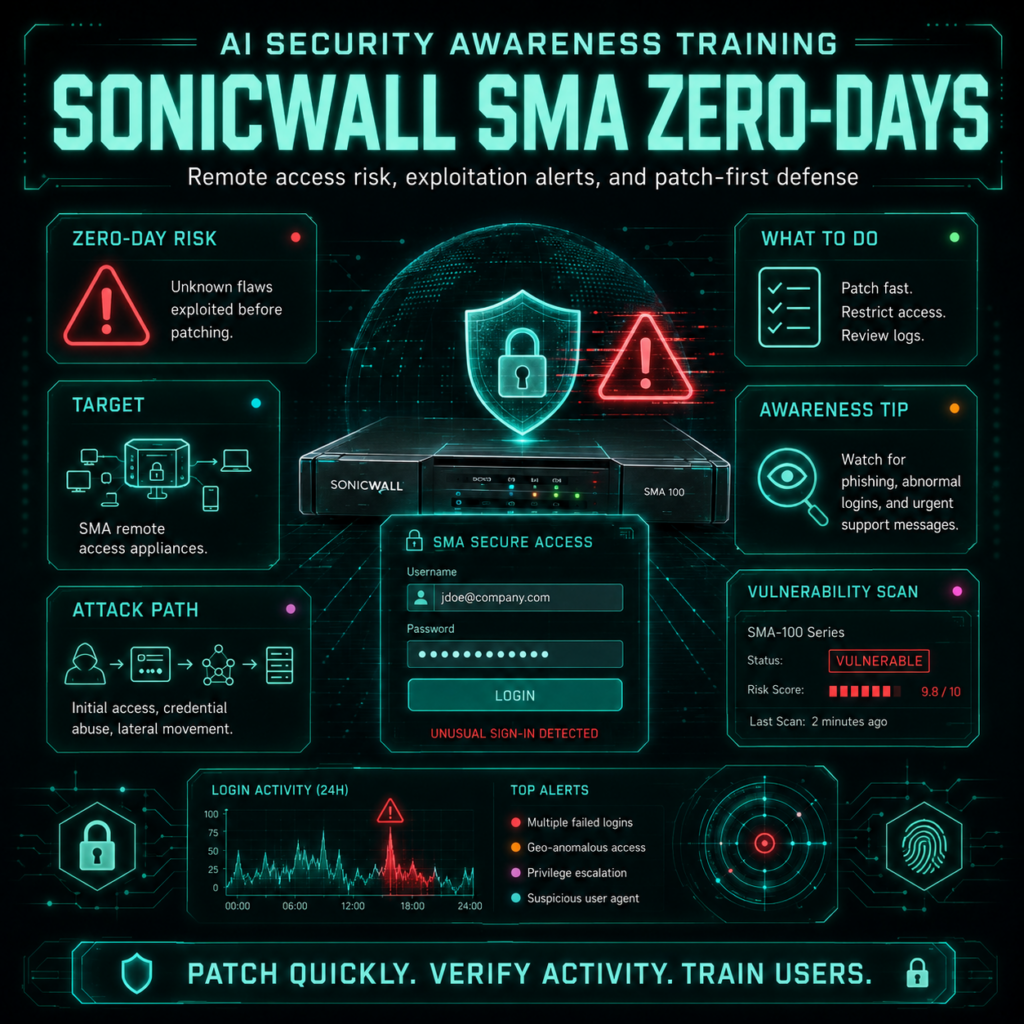
Zero‑day vulnerabilities are the nightmare scenario for every SOC team. In mid‑2026, SonicWall Secure Mobile Access (SMA) appliances were found to contain critical flaws that allow attackers to escalate privileges with a single crafted WebSocket request. This exploit is not just a technical curiosity — it’s a reminder that attackers increasingly blend technical exploitation with social engineering, targeting both systems and people.
For CISOs, IT managers, HR/L&D teams, and SMB decision‑makers, the lesson is clear: patching alone is insufficient. Organizations must combine technical defenses with AI Security Awareness Training to build resilience against evolving threats.
Definition: What Happened?
SonicWall SMA zero‑days exploit weaknesses in WebSocket request handling. By sending a maliciously crafted request, attackers bypass authentication and gain root privileges. This effectively hands over full administrative control of the device, allowing attackers to manipulate traffic, steal credentials, and pivot deeper into enterprise networks.
Key Takeaways
- SonicWall SMA zero‑days enable root access via WebSocket abuse.
- Exploits highlight the need for AI Security Awareness Training to prepare employees for evolving attack vectors.
- SOC teams must integrate patching with Employee Security Training.
- Cybersecurity Training Platforms help enterprises align compliance, risk, and human resilience.
- Preventive measures include layered defense, website risk analysis, automated domain takedown services, and real‑time dark web monitoring solutions.
Why SonicWall SMA Zero‑Days Matter
How the Exploit Works
Attackers send a crafted WebSocket request to SMA appliances. This bypasses normal checks and escalates privileges to root. Once root is obtained, attackers can:
- Deploy ransomware or backdoors.
- Steal credentials and session tokens.
- Disable monitoring tools to remain undetected.
- Use the compromised gateway as a launchpad for lateral movement.
Business Impact
For CISOs and IT managers, the risk includes:
- Regulatory exposure if HR or customer data is accessed.
- Operational disruption for SMBs relying on VPN access.
- Reputational damage if attackers publicize breaches.
- Financial loss from downtime, remediation, and potential fines.
What Organizations Should Learn
Employee Awareness
Even when vulnerabilities are patched, attackers exploit human error. Employees may:
- Click phishing links leading to credential theft.
- Ignore patch notifications.
- Fail to report suspicious activity.
This is where AI Security Awareness Training becomes essential. Training platforms simulate phishing, vishing, smishing, and deepfake scenarios to prepare employees for real‑world threats.
SOC Team Relevance
SOC analysts must integrate:
- Threat intelligence feeds.
- Automated domain takedown services to remove spoofed sites.
- Continuous monitoring of exploit chatter on the dark web.
- Collaboration with HR and compliance teams to ensure awareness programs are aligned with risk.
Practical Examples
- Phishing Simulation: Employees learn to spot fake SonicWall patch notices.
- Smishing Scenario: Attackers send SMS alerts urging “urgent VPN updates.”
- Deepfake Awareness: Executives trained to verify voice instructions before approving access changes.
- Immersive 3D Training: Staff experience simulated breach environments to understand attacker movement.
Common Mistakes / Risks
- Assuming patching alone solves the problem.
- Treating employee training as a compliance checkbox.
- Overlooking insider risk — employees with privileged access.
- Failing to integrate cybersecurity training platforms with SOC workflows.
- Neglecting to measure training effectiveness (e.g., click‑rate reduction).
Actionable Best Practices
- Apply vendor patches immediately.
- Conduct website risk analysis for spoofed portals.
- Deploy real‑time dark web monitoring solutions to detect leaked credentials.
- Run quarterly Employee Security Training
- Measure success with phishing click‑rate reduction and incident reporting metrics.
- Align training with compliance frameworks (ISO 27001, NIST CSF, GDPR).
- Encourage HR and L&D teams to integrate security awareness into onboarding.
- Establish clear reporting channels for suspected phishing or smishing attempts.
How Cyberfrog Helps
Cyberfrog provides an AI Security Awareness Training platform designed for enterprises:
- Realistic phishing and vishing simulations.
- Immersive 3D scenarios for high‑risk roles.
- Automated content creation tailored to compliance needs.
- Human risk reporting integrated with SOC dashboards.
By combining simulations with analytics, Cyberfrog helps organizations prevent cyber attacks before they happen.
Conclusion
SonicWall SMA zero‑days underscore a critical truth: attackers exploit both machines and humans. Technical defenses must be paired with Cybersecurity Training Platforms that empower employees to recognize and resist evolving threats.

Train people for the attacks they actually face.
Build stronger habits with phishing, vishing, smishing, deepfake and immersive simulations employees remember.
👉 Try Cyberfrog for FREE — strengthen your defenses today.
FAQ
1. What is a SonicWall SMA zero‑day?
A vulnerability in SonicWall Secure Mobile Access appliances that allows attackers to gain root control via a crafted WebSocket request.
2. Why is AI Security Awareness Training important here?
Because attackers often combine technical exploits with phishing or social engineering, training ensures employees recognize and report suspicious activity.
3. How can SMBs protect themselves?
Apply patches quickly, deploy a cybersecurity awareness platform for enterprises, and integrate monitoring with SOC workflows.
4. What role does employee training play?
Employee Security Training reduces human error, ensuring staff don’t fall for phishing campaigns exploiting SonicWall vulnerabilities.
5. What tools complement training?
Automated domain takedown services, website risk analysis, and real‑time dark web monitoring solutions provide layered defense.
6. How does Cyberfrog differ from traditional training?
It uses AI‑driven simulations, immersive scenarios, and automated reporting to deliver training that sticks longer than policy reminders.
7. Can training prevent all attacks?
No, but it significantly reduces risk by preparing employees to resist phishing, smishing, and deepfake lures.
8. How should SOC teams measure success?
By tracking reduced phishing click rates, increased incident reporting, and improved compliance audit outcomes.
9. What role do HR and L&D teams play?
They ensure security awareness is embedded into onboarding, continuous learning, and compliance programs.
Make awareness training feel real.
Phishing, vishing, smishing, deepfake and 3D simulations with AI content and unified reporting.