
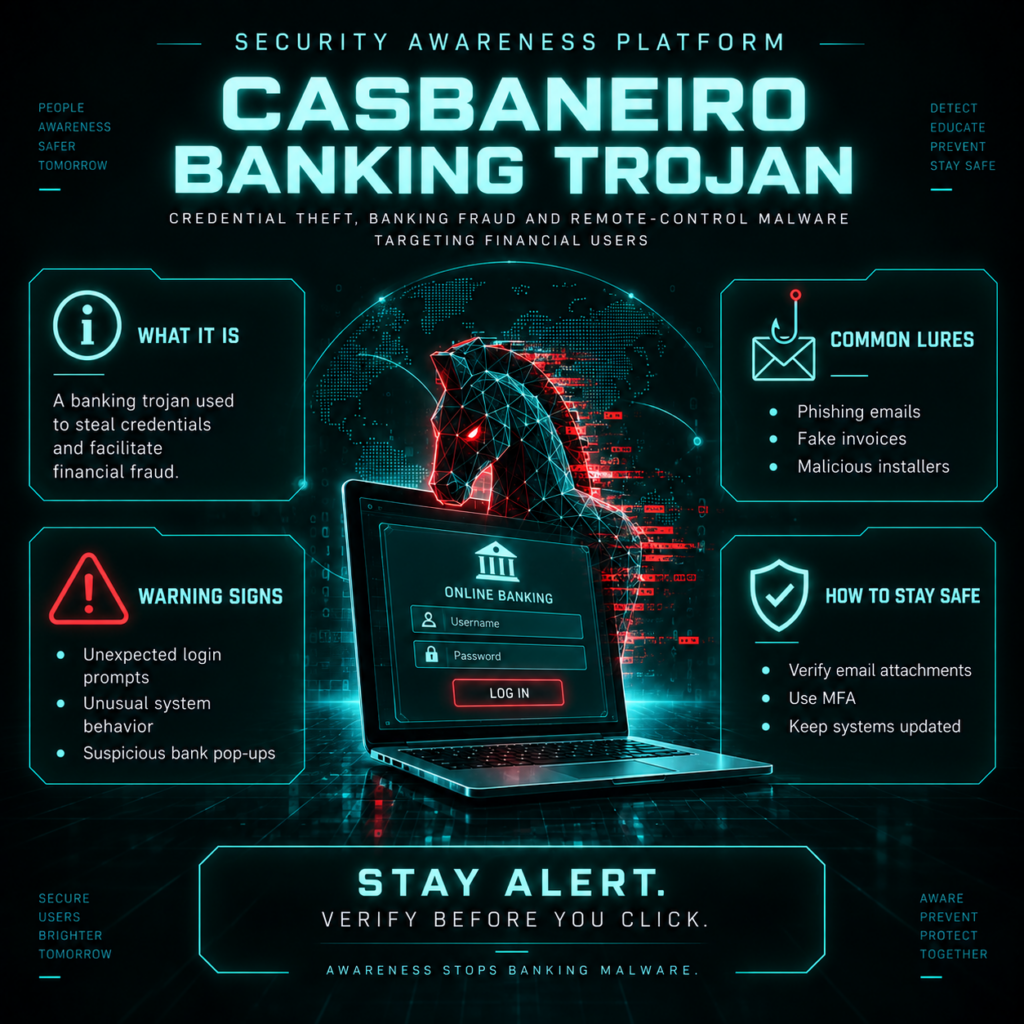
Security Awareness Platform programs can help organizations prepare employees for malware campaigns that begin with something deceptively ordinary: an email. A recent Casbaneiro banking Trojan campaign observed by FortiGuard Labs used phishing emails and PDF documents themed around fake invoices and legal notices to target users in Latin America. The campaign then used geofenced delivery, multiple stages, and distributed servers to make analysis and detection more difficult.
The campaign was observed in August 2026 and targeted users in countries including Argentina, Peru, Colombia, and Mexico. FortiGuard Labs’ analysis shows how a malware infection can combine technical evasion with social engineering, making the employee’s first interaction with the message an important part of the attack chain.
What Happened in the Casbaneiro Campaign?
Casbaneiro is a banking Trojan associated with attacks against financial users in Latin America. In this campaign, attackers reportedly used phishing emails containing PDF files designed around fake invoices, legal notices, and purported legal proceedings.
The documents were designed to create urgency and concern. The recipient’s email address could also appear in the lure, making the message look more personalized and legitimate.
That combination matters for security awareness teams. Employees do not need to understand malware internals to become part of an attack chain. They only need to trust an unexpected document, follow a link, or respond to a convincing request without independently verifying it.
FortiGuard Labs found that the campaign’s infrastructure also used geographic filtering. Visitors outside targeted countries were redirected to legitimate websites, while users from targeted regions were presented with the next stage of the infection.
This makes the campaign particularly useful as a security-awareness case study.
How Casbaneiro Uses Multiple Layers to Avoid Detection
The infection chain did not rely on a single malicious file.
According to FortiGuard Labs, the campaign used an HTA downloader and an AutoIt loader before the final Casbaneiro payload was executed. Components were retrieved separately, which could make individual files appear less suspicious when analyzed in isolation.
The malware also performed environment checks, including checks involving Windows Management Instrumentation, operating-system language, and other characteristics.
These restrictions can make automated analysis more difficult because the malware does not necessarily behave identically in every environment.
For defenders, the broader lesson is straightforward: a suspicious email should not be evaluated only by asking whether its attachment contains obvious malware.
The surrounding behavior matters.
An apparently normal PDF may lead to a website. That website may behave differently depending on the visitor’s location. A downloaded archive may contain another script. Later stages may only activate under specific conditions.
That is why layered security controls remain necessary.
The Human Element Starts the Attack Chain
The technical details of Casbaneiro are significant, but the initial phishing stage is easier for employees to understand.
FortiGuard Labs reported fake invoices and legal notices as the initial lures. These themes exploit familiar workplace pressures: payments, deadlines, legal concerns, and documents that appear to require immediate attention.
Employees should be trained to slow down when a message creates artificial urgency.
Useful warning signs include:
- Unexpected invoices or payment-related documents
- Legal notices that arrive without prior context
- Messages asking recipients to open an unfamiliar document
- Links that do not match the organization or service they claim to represent
- Requests that pressure the recipient to act immediately
- Unusual messages that appear highly personalized
- Documents that direct users to download additional files
- Requests that bypass normal business processes
None of these signs proves that a message is malicious by itself. They are signals that should trigger verification.
A good security culture makes verification normal rather than treating it as an inconvenience.
Why Employee Security Training Needs Realistic Scenarios
Traditional awareness training often explains phishing in general terms. That is useful, but real attacks frequently combine several techniques.
A campaign like Casbaneiro provides an opportunity to turn a current threat into a practical learning scenario.
For example, an organization could create an authorized simulation involving an unexpected invoice or legal document. Employees could be asked to identify warning signs, verify the request through an approved channel, and report the suspicious message.
The objective is not to embarrass people who make the wrong decision.
A phishing simulation is an observation from a controlled exercise. A simulated click does not prove that an employee would have been compromised in a real attack, nor does it establish that someone is permanently high risk.
Instead, repeated simulation results, reporting behavior, training response, and improvement over time can help security teams identify where additional learning may be useful.
Cyberfrog’s current platform is positioned around AI-powered security awareness training, phishing simulations, multi-channel social-engineering exercises, and human-risk reporting. Its published information describes simulations covering email, SMS, QR codes, malicious attachments, voice calls, video deepfakes, and multi-step scenarios.
Security Awareness Platform Programs Should Go Beyond Email
Casbaneiro begins with phishing email, but the underlying lesson is broader.
Employees may encounter social engineering through:
- SMS
- QR codes
- Voice calls
- Collaboration platforms
- Fake document-sharing notifications
- Impersonated colleagues or suppliers
- Fraudulent websites
A mature Security Awareness Platform should therefore support a broader security culture rather than treating phishing as an annual email exercise.
The training should reflect how employees actually work.
Finance teams may need more practice identifying fraudulent invoices. HR teams may encounter malicious documents or recruitment scams. Executives may be targeted with highly personalized requests. IT teams may face fake support or software-update scenarios.
Role-based training can make security education more relevant without overwhelming employees with threats they are unlikely to encounter.

Train people for the attacks they actually face.
Build stronger habits with phishing, vishing, smishing, deepfake and immersive simulations employees remember.
How Security Awareness Training With AI Can Help
Security awareness training with AI can help teams create and adapt educational content more quickly, particularly when a new threat emerges.
For example, a newly reported malware campaign can become a short awareness lesson explaining:
- What the campaign is targeting.
- What employees may see.
- Which warning signs matter.
- What employees should do when something looks suspicious.
- How to report the event.
Cyberfrog currently describes an AI Content Studio that can create security-awareness courses, videos, posters, emails, and incident-based lessons from prompts or uploaded material.
AI should not remove human review. Security teams still need to validate technical details, organizational context, privacy considerations, and the suitability of any training material before it reaches employees.
The value is speed and adaptability, not automatic accuracy.
Distributed C2 Makes the Campaign Harder to Analyze
The technical side of the Casbaneiro campaign also offers an important lesson for security operations.
FortiGuard Labs found that stolen information could be sent to different servers, while command-and-control communication was triggered when the victim visited a targeted banking website. The malware also used responses such as HTTP 403 in a way that could make analysts believe the infrastructure was unavailable.
This behavior complicates investigations because an analyst may not see the complete picture from a single network connection.
FortiGuard also observed malformed HTTP requests, including an absent Host header and unusually large Content-Length values, with request data delivered through many small packets. The researchers said these deviations may help evade network detection or complicate inspection.
For defenders, this reinforces the importance of correlating endpoint, network, email, and threat-intelligence signals.
What Employees Should Learn From the Campaign
The most useful lesson for employees is not a list of Casbaneiro indicators.
It is a decision-making process.
When an unexpected financial, legal, or administrative document arrives, employees should:
- Stop before opening links or downloading unexpected files.
- Check whether the request fits an existing business process.
- Verify unusual requests through a trusted communication channel.
- Avoid allowing urgency to override normal security procedures.
- Report suspicious messages to the security team.
- Ask for assistance when something does not feel right.
These behaviors are simple, but they become much more reliable when employees practise them regularly.
That is where continuous awareness can be more useful than a once-a-year course.
How to Monitor Attack Surface Continuously and Connect Human Risk
The phrase how to monitor attack surface continuously is usually associated with technical assets, but organizations also need to understand how emerging threats interact with their people and workflows.
A new malware campaign may expose weaknesses in several places at once:
- Email security
- Endpoint controls
- Web filtering
- Identity protection
- Employee decision-making
- Security reporting
- Incident response
Security teams should connect these areas rather than treating them as independent programs.
For example, a phishing campaign targeting finance employees can inform awareness content, simulation design, email controls, and incident-response procedures at the same time.
This creates a feedback loop: real threats inform training, training results inform risk priorities, and observed employee behavior can help determine where additional reinforcement is needed.
Cyberfrog’s published material also emphasizes continuous awareness programs, realistic simulations, and behavioral reporting rather than relying solely on course completion.
A Practical Casbaneiro Security Awareness Checklist
Security and awareness teams can use the campaign as a practical exercise:
- Explain why fake invoices and legal notices are effective phishing themes.
- Train employees to recognize artificial urgency.
- Demonstrate how legitimate-looking documents can lead to suspicious websites.
- Teach employees to verify unexpected requests independently.
- Run authorized phishing simulations based on realistic workplace scenarios.
- Measure reporting behavior alongside simulation interactions.
- Provide additional training after repeated difficulties.
- Coordinate awareness teams with SOC and incident-response teams.
- Update awareness content when new malware campaigns affect the organization.
- Reinforce that reporting a suspicious message is a positive security behavior.
The goal is not to make employees suspicious of every email.
It is to help them recognize when normal business communication stops looking normal.
Frequently Asked Questions
What is the Casbaneiro banking Trojan?
Casbaneiro is a banking Trojan that has targeted users in Latin America. FortiGuard Labs reported a 2026 campaign involving phishing emails, fake invoice and legal-notice themes, multi-stage delivery, geofencing, and distributed data-receiving infrastructure.
How did the Casbaneiro campaign reach victims?
The reported campaign began with phishing emails containing PDF documents and links. The lures used themes such as invoices and legal notices. The linked infrastructure then used geographic filtering before delivering additional stages of the infection.
Why should security awareness teams study malware campaigns?
Real malware campaigns provide useful examples of the behaviors employees may encounter. Turning those incidents into controlled training scenarios can help employees practise recognizing suspicious requests, resisting urgency, verifying information, and reporting potential threats.
Can security awareness training prevent banking malware?
Training cannot replace endpoint security, email protection, web security, identity controls, or incident response. It can, however, help reduce the likelihood that an employee follows a malicious link or interacts with a deceptive message that begins an infection chain.
Turn Real Threats Into Practical Security Training
Casbaneiro shows why employee awareness and technical defenses need to work together. The campaign combined convincing phishing lures with geofencing, multiple delivery stages, and distributed infrastructure, making the attack more difficult to analyze and detect.
For organizations building a continuous awareness program, real incidents can serve as practical training material rather than isolated news stories. Cyberfrog positions its Security Awareness Platform around AI‑powered content, realistic phishing simulations, multi‑channel exercises, and human‑risk reporting. Organizations can also review Cyberfrog’s phishing simulation guidance and its Security Awareness Platform guidance for actionable approaches to continuous employee education — and they must try Cyberfrog to experience how these methods strengthen resilience.
Note: Information on the Casbaneiro campaign presented in this article is primarily sourced from FortiGuard Labs’ research and the GBHackers report. Current coverage highlights activity targeting users in Latin America, but it does not confirm that all recipients of similar phishing attempts were compromised.
Disclaimer: Cyberfrogsecurity.com relies on publicly available threat‑intelligence sources. Reference to any organization does not indicate verified compromise. All claims are attributed to external sources unless independently confirmed.
Make awareness training feel real.
Phishing, vishing, smishing, deepfake and 3D simulations with AI content and unified reporting.