
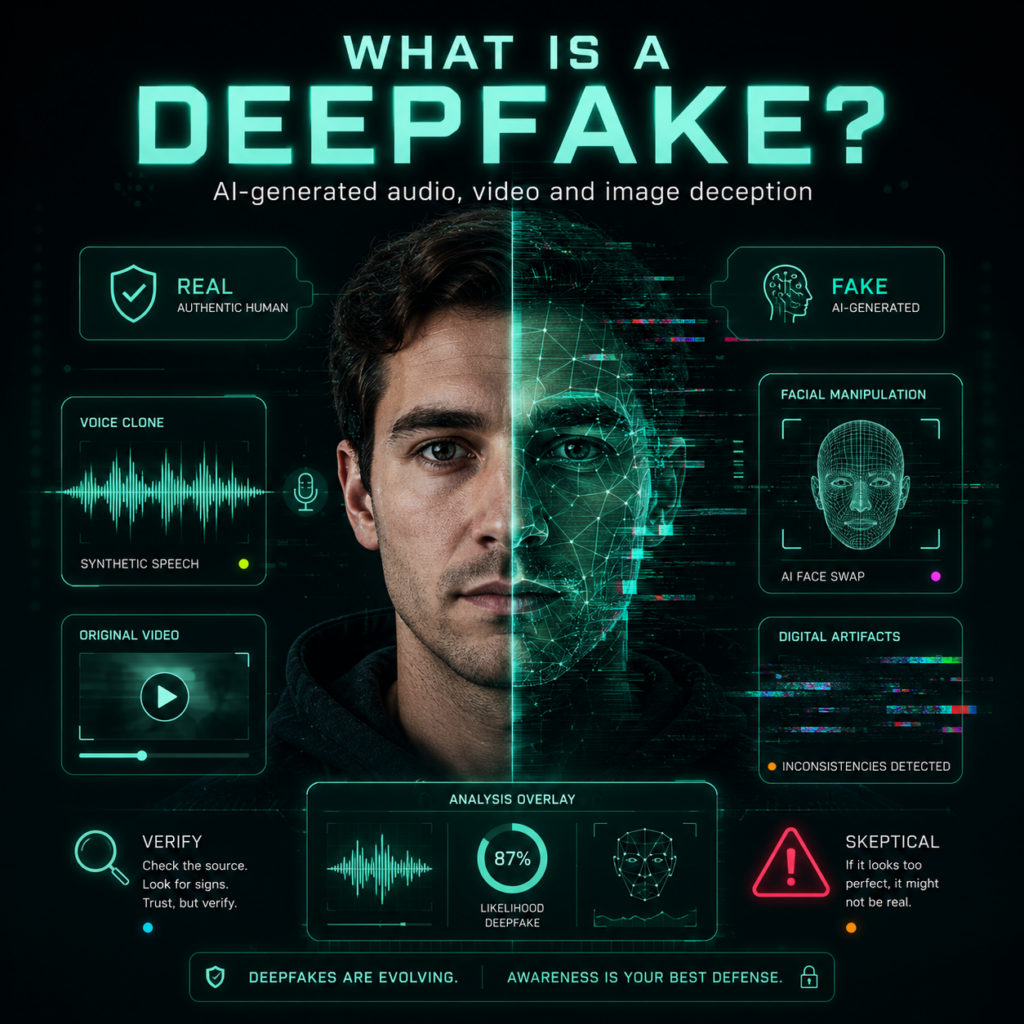
What is a deepfake, and why has this technology become such an important cybersecurity concern? A deepfake is an image, video or audio recording created or manipulated with artificial intelligence to make a person appear to say or do something that never happened. Some examples are created for entertainment, education or creative production. Others are designed to deceive, impersonate trusted people or influence decisions.
As artificial intelligence becomes more accessible, realistic fake content can be produced faster and with fewer technical skills. 🤖 This creates new challenges for individuals and organisations because seeing a familiar face or hearing a recognisable voice is no longer enough to prove that a message is genuine.
Understanding how deepfakes work is now an essential part of digital literacy and security awareness.
What is a deepfake?
A deepfake is a piece of digital content that has been generated or altered using artificial intelligence. It may reproduce someone’s face, voice, expressions or movements with enough realism to appear authentic.
The term combines “deep learning” and “fake.” Deep learning systems analyse large collections of images, videos or audio samples to identify patterns. They can then use those patterns to reconstruct a face, imitate a voice or create an entirely new scene.
The U.S. Government Accountability Office defines a deepfake as a video, photograph or audio recording that appears real but has been manipulated using AI. The technology can replace faces, change expressions and synthesise speech.
In simple terms, a deepfake may involve:
- Replacing one person’s face with another
- Making someone appear to speak words they never said
- Reproducing a person’s voice from recorded samples
- Changing expressions or lip movements
- Creating a realistic person who does not exist
- Generating a false video meeting or telephone conversation
This form of synthetic media can be convincing because it combines realistic visual or audio elements with a believable context. 🎭
How does deepfake technology work?
Deepfake creation begins with data. An AI system is trained using photographs, recordings or videos of a person. The more varied and detailed the source material is, the easier it may be for the system to reproduce that person’s appearance or voice.
Artificial neural networks analyse characteristics such as facial structure, speaking rhythm, pronunciation, head movement, lighting and expressions. The system then generates new content based on those patterns.
A traditional video deepfake may use facial manipulation to place one person’s face over another actor’s body. More advanced tools can generate facial movement, synchronise lips with new dialogue and adapt expressions to match the emotional tone of the recording.
Audio attacks often use voice cloning. A model studies how a person speaks and then generates new phrases in a similar voice. This makes it possible to create a convincing telephone message without requiring the real person to record those words.
Modern generative AI has also reduced the amount of specialist knowledge required. 🧠 Some tools can now produce realistic media through guided interfaces, automated models or simple written instructions.
The most common types of deepfake
Deepfakes can appear in several formats. Understanding these formats helps employees and consumers recognise that the threat is not limited to manipulated videos.
| Type | How it works | Common risk |
|---|---|---|
| Video deepfake | Replaces or modifies a person’s face and movements | Executive impersonation |
| Audio deepfake | Reproduces a person’s voice | Fraudulent payment requests |
| Image deepfake | Creates or alters a realistic photograph | Fake profiles and identity fraud |
| Live deepfake | Changes video or audio during a live call | False meetings and interviews |
| Text-based impersonation | Reproduces a person’s writing style | Fraudulent messages and instructions |
A live deepfake can be particularly challenging because the attacker may react during a conversation. Instead of sending a prerecorded clip, the system modifies the attacker’s appearance or voice in near real time.
Businesses must therefore prepare employees to verify requests based on process, not simply on whether the person looks or sounds familiar.
Why are deepfakes a cybersecurity risk?
Deepfakes introduce a powerful new layer to social engineering. Traditional attackers may impersonate an executive through email. A more sophisticated attacker can combine the email with a convincing voice call or video meeting.
The message may request an urgent bank transfer, confidential document, password reset, authentication code or change to supplier payment details. ⚠️ Because the supposed sender appears to be a known executive, colleague or customer, the victim may feel pressure to act quickly.
The NSA, FBI and CISA have warned that deepfakes can be used to impersonate organisational leaders, damage brands and facilitate access to networks or sensitive information. Their guidance recommends verification technologies, response planning and personnel training.
Common business risks include:
- Executive impersonation and payment fraud
- Theft of login credentials or authentication codes
- False instructions sent to employees
- Fraudulent customer or supplier communications
- Reputational damage caused by fake statements
- Manipulation of recruitment or identity checks
- Disinformation targeting customers or investors
Digital impersonation succeeds when an attacker combines technical realism with emotional pressure. Urgency, confidentiality and authority can cause employees to bypass normal security procedures.
How to spot a deepfake video
People frequently search for how to spot a deepfake video, but there is no single visual clue that proves content is false. Deepfake detection requires a combination of observation, contextual analysis and independent verification.
Begin by examining the person’s face and movement. Look for unnatural blinking, irregular expressions, unusual skin texture or a lack of synchronisation between speech and lip movement. Lighting or shadows may also behave differently around the face.
Audio may contain unnatural pauses, changes in tone, missing background sounds or pronunciation that feels slightly inconsistent. 🔍 However, these warning signs are becoming less reliable as production tools improve.
Use the following checks:
- Compare the message with the person’s normal communication style.
- Ask whether the request is expected and reasonable.
- Look for unusual urgency or demands for secrecy.
- Verify important instructions through a separate channel.
- Check the original source instead of relying on a forwarded clip.
- Search for an official version of the statement.
- Escalate suspicious content to the security team.
Deepfake detection should never depend exclusively on the employee identifying technical imperfections. A convincing fake can still be defeated when the organisation has strong verification processes.
Can a deepfake be perfectly convincing?
Question: Can a deepfake be so realistic that an ordinary person cannot recognise it?
Answer: Yes, a high-quality deepfake may not contain obvious visual or audio mistakes. This is why authentication and verification are more dependable than relying only on human observation.

Train people for the attacks they actually face.
Build stronger habits with phishing, vishing, smishing, deepfake and immersive simulations employees remember.
An employee should not be expected to analyse pixels during an urgent video call. Instead, the employee should follow a standard process whenever a request involves money, credentials, sensitive information or a major change in procedure.
For example, a finance employee receiving an unexpected payment request from a supposed director should call the director using a previously verified telephone number. The employee should not use contact information supplied during the suspicious conversation.
This approach remains effective even when the quality of the fake improves.
Practical checklist for deepfake detection
Use this checklist when you receive a suspicious audio recording, video, image or live call:
- Is the communication unexpected?
- Does the person request money, credentials or confidential information?
- Is there pressure to act immediately?
- Are you being told not to contact anyone else?
- Does the request bypass an established business process?
- Can you confirm the person’s identity through another channel?
- Is the account, telephone number or meeting invitation familiar?
- Can the request wait while verification takes place?
- Have you reported the interaction to the security team?
If several warning signs appear together, stop the interaction and verify it independently. ✅ Do not accuse the caller or attempt to investigate the attacker yourself.
Employees should also know that reporting is valuable even when they have already replied, clicked or shared information. Rapid reporting gives the organisation more time to block accounts, protect funds and notify other potential targets.
How organisations can reduce deepfake risk
Technology can support deepfake detection, but organisations also need policies, training and repeatable verification procedures.
Start by identifying the roles most likely to be impersonated. These may include executives, finance leaders, IT administrators, human resources staff and employees authorised to approve payments.
Next, identify the employees most likely to receive sensitive requests. Finance, customer support, executive assistants and recruitment teams may need role-specific scenarios.
A strong defence should include:
- Mandatory verification for unusual financial requests
- Two-person approval for sensitive transactions
- Trusted contact channels for executives
- Clear procedures for reporting suspicious communications
- Regular exercises involving audio and video impersonation
- Incident-response plans for manipulated content
- Monitoring for fraudulent accounts and fake profiles
The goal is not to make employees distrust every video call. It is to create a culture in which pausing and verifying are normal professional behaviours.
The federal guidance on deepfake threats to organisations also recommends planning and rehearsing responses, protecting high-priority communications and training personnel.
Why security awareness training matters
Deepfake defence is ultimately a combination of technical controls and human judgement. Employees need opportunities to experience realistic scenarios before they encounter a genuine attack.
Passive training may explain what is a deepfake, but practical exercises teach employees how to respond under pressure. A simulated video call, voice message or executive request allows users to practise stopping, checking, verifying and reporting.
Cyberfrog’s security awareness training platform is designed around multi-channel simulations, including phishing, smishing, vishing, malicious QR codes and deepfake-driven scenarios. It also includes immersive 3D environments and reporting capabilities for measuring human risk.
Organisations can also explore why modern awareness training needs to feel real. Realistic scenarios help employees recognise emotional manipulation, respond to unexpected requests and practise safer decisions in a controlled environment.
For a broader programme, these 10 ways to build cyber resilience explain how continuous learning, simulations and behavioural measurement can strengthen employee preparedness.
Building a practical response plan
Every organisation should decide what happens after a suspected deepfake is reported.
The security team should preserve the original message, recording or meeting invitation. It should then verify the identity of the supposed sender, review related accounts and determine whether any employee disclosed information or approved a transaction.
Communications teams may also need to respond if the content is published publicly. A false video associated with a company executive can affect customers, employees and business partners even when no internal system has been compromised.
A basic response process should cover:
- Immediate reporting
- Preservation of evidence
- Independent identity verification
- Account and transaction review
- Containment of affected systems
- Internal and external communication
- Lessons learned and follow-up training
Employees must know where to report the incident and feel confident that they will not be punished for raising a concern. 🛡️ A supportive reporting culture reduces delay and gives responders more time to limit the impact.
Conclusion
What is a deepfake? It is AI-created or AI-manipulated media capable of making people appear to say or do things that never happened. The technology has legitimate uses, but it can also support fraud, disinformation and highly convincing impersonation attacks.
Visual clues remain useful, but how to spot a deepfake video is no longer only a question of appearance. Context, trusted procedures and independent verification are equally important. Effective deepfake detection combines employee awareness, secure approval processes, technical tools and rehearsed incident response.
Organisations should prepare now by training employees to question unexpected requests, verify identities through a second channel and report suspicious communications immediately. 🚀
Discover much more in our complete guide: Explore the Cyberfrog security awareness blog.
Visit Cyberfrog Security and discover realistic simulations, AI-powered content and immersive 3D security training.
Make awareness training feel real.
Phishing, vishing, smishing, deepfake and 3D simulations with AI content and unified reporting.