
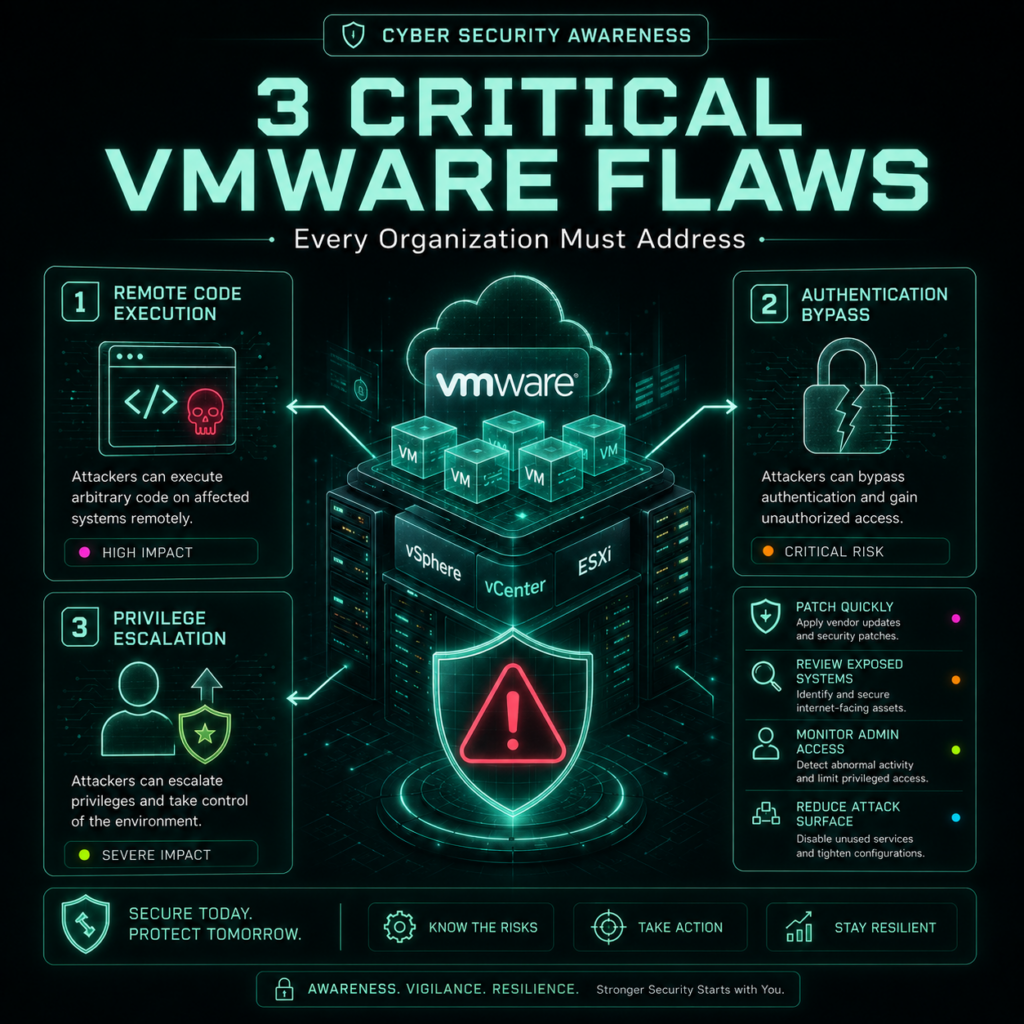
Virtualization platforms sit at the heart of modern enterprise infrastructure, making them attractive targets for cybercriminals. Recent reports have revealed three critical VMware vulnerabilities capable of enabling authentication bypass, remote code execution, and even virtual machine (VM) escape. These flaws highlight why Cyber Security Awareness is no longer just an IT concern but a business priority that affects every organization relying on virtualization technologies. 🔐
The vulnerabilities underscore the importance of proactive defense strategies, employee education, and continuous monitoring. Organizations that combine technical controls with Human Risk Management programs and a modern Cybersecurity Training Platform are significantly better positioned to detect suspicious activity before attackers can gain a foothold.
According to reporting from The Hacker News, organizations should immediately apply vendor patches and review their VMware deployments to reduce exposure before threat actors weaponize these vulnerabilities.
Understanding the Three VMware Vulnerabilities
The newly disclosed VMware flaws impact critical virtualization components that organizations depend on for cloud infrastructure, private data centers, and virtual desktop environments.
The reported vulnerabilities include:
| Vulnerability | Potential Impact |
| Authentication Bypass | Attackers may gain unauthorized access without valid credentials |
| Remote Code Execution | Malicious actors can execute arbitrary code on vulnerable systems |
| VM Escape | Attackers may move from a compromised virtual machine to the underlying host |
Each vulnerability is dangerous individually. Combined, they create an attack chain capable of giving adversaries elevated control over enterprise infrastructure.
Security researchers emphasize that virtualization layers are particularly attractive because compromising them can expose multiple workloads simultaneously.
Why These Flaws Matter to Every Business 💻
Virtualization has become the backbone of modern IT operations.
Many organizations host:
- Business-critical applications
- Customer databases
- Development environments
- Backup infrastructure
- Cloud workloads
A successful VM escape could allow an attacker to cross security boundaries that organizations often assume are isolated.
Instead of compromising a single server, attackers may gain opportunities to interact with numerous virtual machines hosted on the same physical infrastructure.
This dramatically increases the potential impact of an attack.
How Attackers Could Exploit the Vulnerabilities
Although technical exploitation varies depending on the environment, a typical attack path may look like this:
- Discover exposed VMware services.
- Exploit authentication bypass.
- Execute malicious code.
- Escalate privileges.
- Escape the compromised virtual machine.
- Move laterally across the environment.
- Access sensitive corporate systems.
This progression illustrates why layered security remains essential.
Even if one security control fails, additional defenses can interrupt the attack chain before serious damage occurs. 🛡️
The Growing Importance of Cyber Security Awareness
Technology alone cannot eliminate cyber risk.
Employees frequently become the first line of defense by identifying suspicious behavior, phishing attempts, or abnormal system activity.
Strong Cyber Security Awareness initiatives help employees:
- Recognize social engineering attacks
- Report suspicious emails quickly
- Understand privilege abuse
- Follow secure authentication practices
- Reduce accidental security mistakes
Organizations investing in ongoing awareness programs consistently reduce successful attack rates.
Human Risk Management Strengthens Enterprise Security 👥
Modern security extends beyond firewalls and endpoint protection.
Human Risk Management helps organizations understand how employee behavior contributes to cyber resilience.
Rather than assigning generic training, organizations evaluate:
- Employee risk profiles
- Phishing susceptibility
- Security knowledge
- Privileged access
- Department-specific threats
This data-driven approach enables targeted education where it is needed most.
As enterprise attacks become increasingly sophisticated, reducing human error becomes just as important as deploying technical safeguards.
Why a Cybersecurity Training Platform Matters
Traditional annual awareness sessions no longer provide sufficient protection.
A modern Cybersecurity Training Platform delivers continuous learning through:
- Interactive lessons
- Simulated phishing campaigns
- Real-world attack scenarios
- Security quizzes
- Risk-based reporting
Instead of treating awareness as a compliance requirement, organizations transform it into an ongoing security capability.
This approach also supports AI-powered security awareness training, allowing learning content to adapt to employee behavior and emerging threats. 🤖
Question: Can Patching Alone Prevent These Attacks?
Short answer: No.
Patching is essential but represents only one layer of defense.
Organizations should also:
- Monitor privileged accounts
- Review VMware configurations
- Segment critical infrastructure
- Limit administrative access
- Enable continuous monitoring
- Educate employees
Cybersecurity works best when prevention, detection, and response operate together.
Practical Checklist for VMware Security ✅
Use this checklist immediately after reviewing your VMware environment.

Train people for the attacks they actually face.
Build stronger habits with phishing, vishing, smishing, deepfake and immersive simulations employees remember.
✔ Apply the latest VMware security updates
✔ Inventory all VMware assets
✔ Disable unnecessary services
✔ Restrict administrative privileges
✔ Enable multi-factor authentication
✔ Monitor privileged account activity
✔ Review network segmentation
✔ Audit exposed management interfaces
✔ Validate backup integrity
✔ Conduct incident response exercises
These practical measures significantly reduce attack opportunities.
Security Teams Should Also Watch Beyond Internal Networks
Threat actors rarely operate solely within corporate environments.
They also exploit leaked credentials, exposed assets, and publicly available intelligence.
Organizations should monitor for:
- Credential leaks
- Impersonation domains
- Supply chain threats
- Stolen administrator accounts
- dark web surveillance
- External attack surface exposure
- cyber threat exposure
Proactive monitoring helps identify warning signs before attackers initiate broader campaigns.
Protecting Employees Outside the Corporate Network 🌐
Remote work continues to expand the enterprise attack surface.
Employees increasingly access sensitive systems from various locations and personal devices.
Organizations should consider implementing Dark web exposure monitoring for employees to identify compromised credentials before they are abused.
Combined with strong authentication and continuous education, this strategy helps reduce account takeover risk.
Building a More Resilient Security Program
Security leaders should view these VMware vulnerabilities as an opportunity to strengthen their overall cybersecurity strategy.
Effective programs combine:
- Vulnerability management
- Asset visibility
- Continuous monitoring
- Threat intelligence
- Employee education
- Incident response readiness
Organizations should also consider brand abuse detection capabilities to identify malicious domains impersonating corporate identities, alongside trusted brand protection software that helps reduce phishing and impersonation risks targeting customers and employees. 📊
Cyber resilience is built through multiple overlapping controls rather than relying on a single technology.
Stay Ahead of Emerging Threats
The VMware vulnerabilities demonstrate how quickly attackers can capitalize on newly disclosed weaknesses.
Security teams should continuously:
- Track vulnerability advisories
- Patch systems rapidly
- Validate security configurations
- Train employees regularly
- Test incident response procedures
Organizations that integrate Cyber Security Awareness, proactive monitoring, and behavioral risk reduction create stronger defenses against evolving cyber threats.
Industry experts consistently recommend treating virtualization infrastructure as a high-value asset deserving continuous monitoring, rigorous patch management, and frequent security assessments.
Conclusion 🎯
The three newly disclosed VMware vulnerabilities serve as a powerful reminder that virtualization security cannot be overlooked. Authentication bypass, remote code execution, and VM escape each represent significant enterprise risks, but together they create an even more dangerous attack chain.
Technical safeguards remain essential, yet they must be complemented by Human Risk Management, an adaptive Cybersecurity Training Platform, and ongoing Cyber Security Awareness initiatives. By combining timely patching, continuous monitoring, employee education, and external threat visibility, organizations can significantly reduce the likelihood of successful attacks while strengthening their overall cyber resilience.
Discover much more in our complete guide
Disclaimer: Cyberfrogsecurity.com reports on publicly available threat-intelligence sources. Inclusion of an organization in an article does not imply confirmed compromise. All claims are attributed to external sources unless explicitly verified.
Make awareness training feel real.
Phishing, vishing, smishing, deepfake and 3D simulations with AI content and unified reporting.