
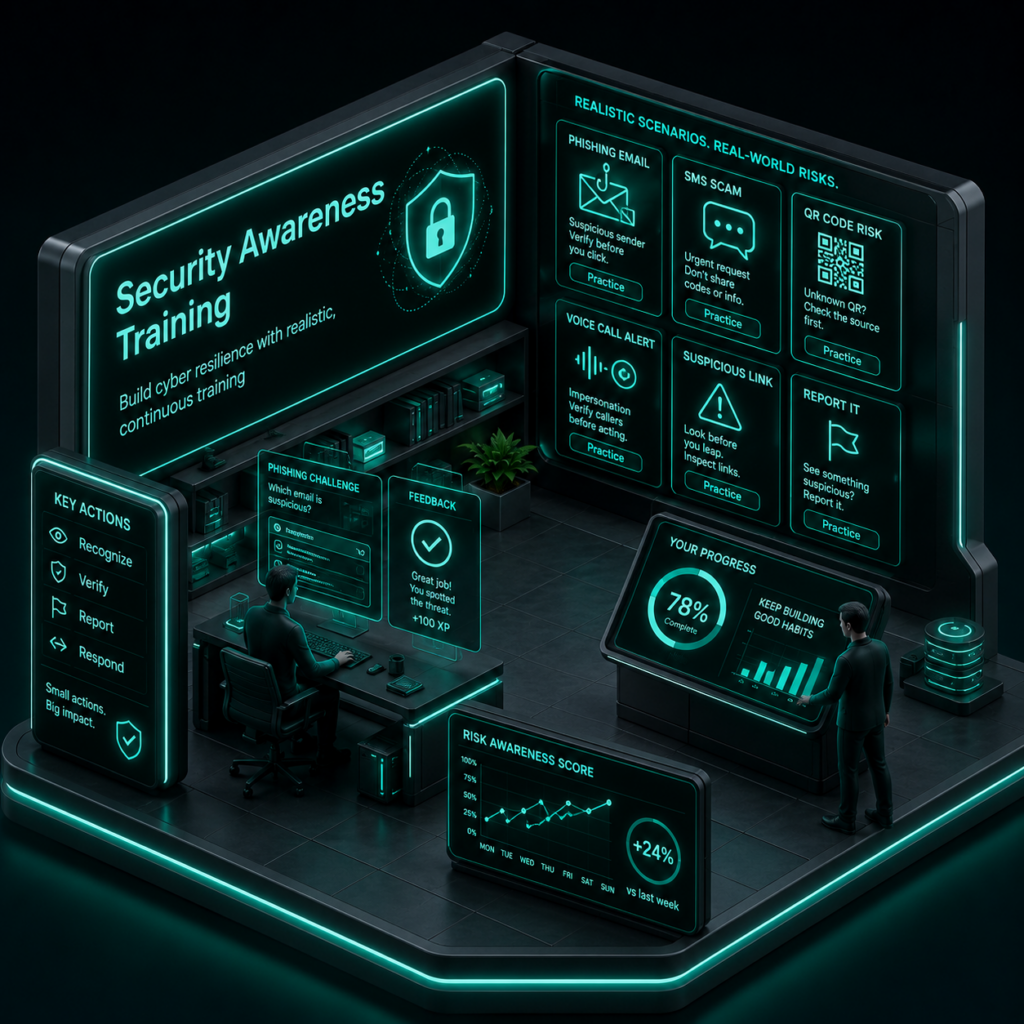
Security awareness training should do more than help employees pass an annual quiz. It should prepare people to recognize pressure, deception, urgency, and manipulation during a normal working day. Modern attacks arrive through email, SMS, QR codes, phone calls, shared documents, and convincing AI-generated video. A resilient program therefore needs to feel practical, relevant, and close to real life. 🛡️
The goal is not to turn every employee into a cybersecurity specialist. It is to help people pause, verify, protect information, and report suspicious activity quickly. When learning is continuous, interactive, and measurable, organizations can reduce avoidable mistakes while building confidence. This guide explains ten ways to modernize employee cybersecurity training and make awareness an everyday business capability.
Why traditional awareness programs lose impact
Many organizations still treat awareness as a yearly compliance task: employees watch a presentation, answer questions, and return to work. That approach records completion but rarely reflects real decisions under pressure.
Real attacks exploit context: fake invoice approvals, messages from supposed managers, or convincing voice calls. Learning must reflect these situations rather than rely only on generic definitions.
NIST phishing guidance recommends teaching employees to recognize and report phishing while remembering that attacks can arrive through text messages, phone calls, social media, and other channels—not email alone.
1. Make learning continuous instead of annual
People forget information they do not use. A yearly course leaves long gaps while habits fade and attacks evolve. Use short learning moments instead: a two-minute video, realistic scenario, quick quiz, or timely reminder. 🎯
Continuous security awareness training keeps important behaviors visible without overwhelming employees. A practical cadence might include:
- One short lesson each month
- One simulation every six to eight weeks
- Immediate feedback after risky actions
- Quarterly reporting for managers
- Refresher content for higher-risk groups
The purpose is repetition with variety, not repetition for its own sake.
2. Replace passive content with realistic decisions
Employees learn more when they must choose. Place them inside a believable situation: a manager requests a transfer, IT asks for a one-time code, or a visitor seeks restricted access.
Video-based stories and interactive 3D environments can show consequences, allow branching decisions, and provide a debrief. 🧠 The lesson becomes easier to remember because the employee actively responds rather than passively watches.
Cyberfrog’s immersive awareness features are built around realistic multi-channel scenarios, short lessons, measurable outcomes, and interactive 3D experiences.
3. Train across every attack channel
Email remains important, but employees also face smishing, vishing, quishing, malicious attachments, calendar invitations, collaboration-platform lures, and synthetic media. A program that tests only email creates blind spots.
Modern employee cybersecurity training should safely reflect daily communication. Finance may need invoice exercises, customer support may need account-verification scenarios, and sales teams may need mobile-message simulations.
| Channel | Example risk | Desired action |
|---|---|---|
| Fake login or invoice | Inspect, verify and report | |
| SMS | Urgent account alert | Avoid the link and confirm independently |
| QR code | Hidden malicious destination | Check the context before scanning |
| Phone | Fake IT request | Refuse disclosure and call a trusted number |
| Video | Deepfake authority figure | Verify through a second channel |
This multi-channel approach reflects how social engineering works in practice.
4. Personalize content by role and behavior
Generic content often feels irrelevant. Employees engage more when training reflects their responsibilities, tools, and exposure. Finance teams face payment fraud. HR handles personal information. Developers manage credentials and code. Executives are frequent impersonation targets.
Personalization can respond to behavior. Consistent reporters may be ready for advanced scenarios, while repeated risky actions may call for targeted coaching.
Security awareness training becomes more useful when learning pathways branch according to quiz scores, simulation outcomes, role, department, or previous incidents. This makes better use of employees’ time and shows where extra support is required.
5. Use simulations as teaching moments, not traps
Phishing simulations should build judgment, not embarrass people. When employees think the security team is trying to catch them, they may hide mistakes or distrust future exercises. A supportive program explains the purpose, avoids public shaming, and provides useful feedback immediately. 🎬
The NIST Phish Scale helps teams rate how difficult a simulated email is to detect, making campaign results easier to interpret.
After each exercise, show the clues that mattered. Explain what the employee did well, what created risk, and what action to take next time. This supports behavior change better than a simple pass-or-fail message.
6. Teach verification, not suspicion
Employees cannot treat every message as malicious. That would slow down work and create alert fatigue. The practical skill is verification: knowing when to pause and how to confirm a request safely.
Use a simple four-step method:
- Stop when a request involves money, credentials, sensitive data, or unusual urgency.
- Check the sender, destination, context, and requested action.
- Confirm the request through a trusted second channel.
- Report the interaction when anything remains suspicious.
This strengthens cyber hygiene without asking employees to become investigators. It also gives them a repeatable response under pressure. 🎣
7. Make reporting fast and psychologically safe
Question: What is the most important action after spotting a suspicious message?
Answer: Report it immediately through the approved channel, even after clicking, replying, or sharing information.
Fast incident reporting gives security teams time to investigate, block infrastructure, reset credentials, and warn others. A healthy security culture treats early reporting as a success, not a failure.
Keep the process simple: one reporting button, one mailbox, or one documented workflow. Then acknowledge reports and share the outcome when appropriate. ✅ Feedback proves that reporting matters.
8. Measure behavior, not only completion
Completion rates are useful for administration, but they do not reveal whether employees make safer decisions. Better metrics focus on observable actions and trends:
- Reporting rate
- Time to report
- Repeat interaction rate
- Sensitive-data disclosure rate
- Quiz improvement
- Risk by department
- Coverage across attack channels
A unified dashboard helps leaders distinguish compliance activity from measurable resilience. Cyberfrog describes cross-channel reporting that combines clicks, disclosure events, quiz results, exposure, and risk trends in one view.
The goal is not to create a list of “bad users.” It is to identify patterns and direct resources where they will reduce risk most effectively. 📊
9. Connect training to real incidents
The most memorable lessons are often based on events employees recognize. When a real phishing attempt, credential exposure, or process failure occurs, turn it into a short anonymized lesson. Explain what happened, why the tactic worked, and what people should do differently.
This creates relevance without blaming individuals. The Cyberfrog AI Content can transform prompts or uploaded incident material into courses, videos, posters, emails, and story-driven multilingual lessons.
Real-event learning is especially valuable when delivered while the context is still familiar.
10. Build a culture supported by leaders
Awareness cannot belong only to the security department. Managers influence whether employees feel comfortable questioning unusual requests, delaying a transaction, or reporting a mistake. Leaders should model verification, use approved tools, and praise responsible escalation.
This is the foundation of how to build a security-conscious workforce. Policies define expectations, but everyday examples determine whether those expectations become normal behavior.
A mature program aligns leadership communication, onboarding, simulations, microlearning, and measurement. Employee cybersecurity training then becomes part of how the organization works—not an interruption added once a year.
Practical checklist for a stronger program
Use this checklist to review your current approach:
- Is learning delivered throughout the year?
- Does it include video, interactive scenarios, or 3D environments?
- Are phishing simulations realistic and ethically designed?
- Do exercises cover email, SMS, QR, voice, and deepfake risks?
- Is content adapted by role, language, or previous behavior?
- Can employees report suspicious activity in one simple step?
- Do managers reinforce safe actions?
- Are results measured beyond completion rates?
- Is real incident data converted into relevant learning?
- Can leadership see risk trends over time?
If several answers are “no,” begin with two improvements: shorten the learning cycle and increase realism. These changes can make the program more relevant without adding unnecessary complexity. 🚀
From compliance to lasting resilience
Security awareness training works best when it prepares people for real decisions. Continuous lessons maintain attention, believable simulations build judgment, and clear reporting turns employees into an active part of the defense system.
The transformation does not require longer courses. It requires better moments: relevant content, convincing situations, fast feedback, supportive leadership, and metrics that show whether decisions are improving. That is how to build a security-conscious workforce while respecting employees’ time.
Explore Cyberfrog’s next-generation awareness platform to see how AI content, realistic simulations, video training, immersive 3D scenarios, multilingual delivery, and unified reporting can support a continuous program.