
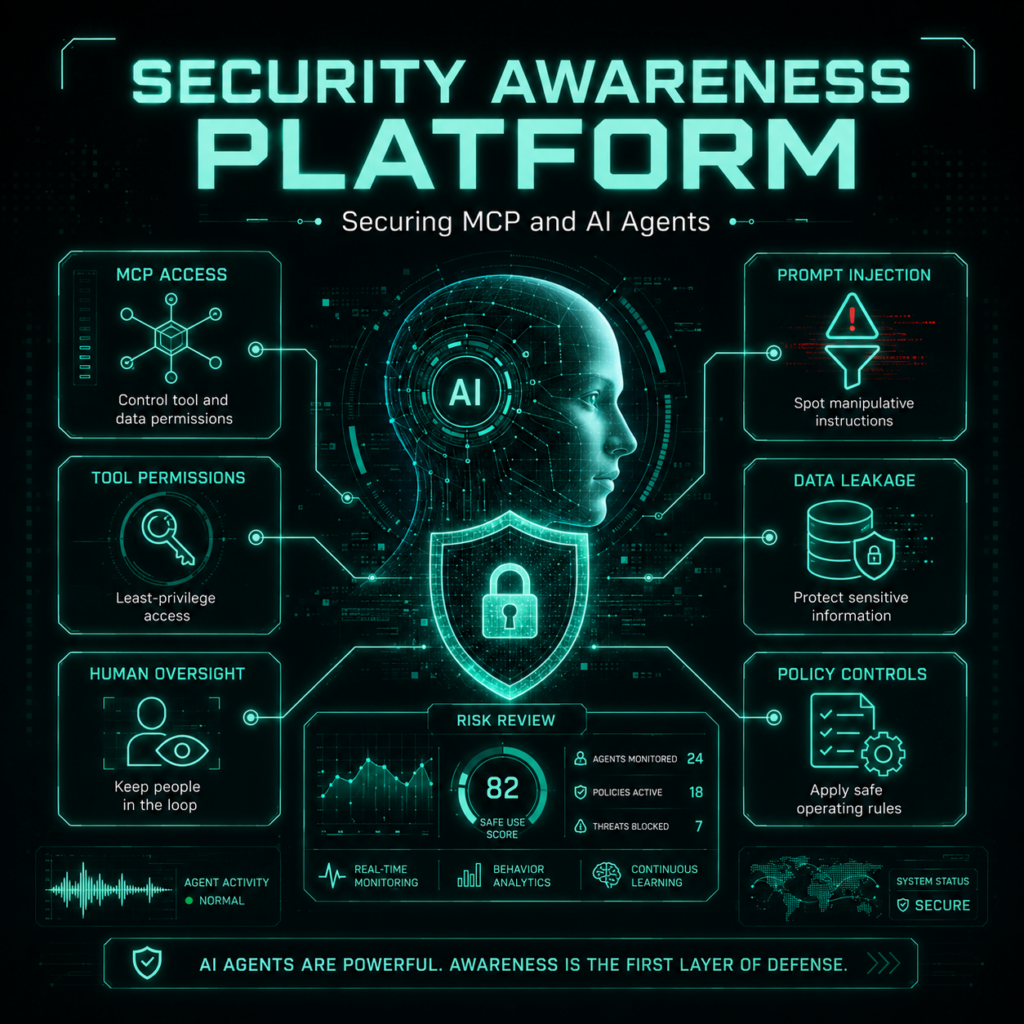
Security Awareness Platform guidance is becoming relevant far beyond traditional phishing emails. As organizations connect AI agents to enterprise applications through the Model Context Protocol (MCP), employees, developers, and security teams must understand a new class of risk involving trusted tools, sensitive data, credentials, and prompt injection. The Hacker News reported on August 17, 2026, that MCP servers can expose enterprise secrets through plaintext configuration, excessive permissions, credential sprawl, prompt injection, and untrusted servers.
The important lesson is not that MCP is inherently unsafe. MCP can provide a practical standardized way for AI assistants and agents to interact with external tools and data. The security challenge is that these connections can give AI systems access to real enterprise resources, meaning technical controls and human decision-making must evolve together.
Why MCP security is becoming a human-risk issue
Model Context Protocol allows an AI agent to interact with external systems such as databases, files, APIs, and enterprise applications through MCP servers. In practice, an MCP server can act as an intermediary between an AI agent and the systems the agent is authorized to use.
That architecture changes the security conversation. An AI agent may no longer simply generate text. It may retrieve information, invoke tools, and perform actions using credentials or non-human identities.
This creates several connected risks:
- Credentials may be stored insecurely in configuration files or environment variables.
- Excessive permissions can give an agent access to more resources than its task requires.
- Long-lived secrets increase the consequences of credential exposure.
- Untrusted MCP servers introduce supply-chain considerations.
- Malicious instructions embedded in external content can contribute to indirect prompt injection.
- Employees may approve or trust AI-generated actions without independently verifying sensitive requests.
NIST has separately highlighted agent hijacking, including indirect prompt injection, as a security concern when AI agents process untrusted external information.
For security leaders, that means MCP governance should not sit exclusively with developers. Security awareness, secure workflows, identity controls, and employee judgment all have a role.
What MCP prompt injection means for employees
Prompt injection is often discussed as a technical AI-security problem, but its human component deserves equal attention.
An AI agent may process information from an email, document, web page, ticket, repository, or another external source. If that content contains instructions designed to manipulate the agent, the system may be influenced into taking an unintended action. NIST describes this broader category as agent hijacking or indirect prompt injection.
Employees can encounter the same manipulation techniques that already make phishing effective:
- Authority: a request appears to come from a trusted manager or system.
- Urgency: the employee is encouraged to approve something immediately.
- Familiarity: a legitimate-looking workflow or application is used as context.
- Curiosity: an unusual document or notification encourages investigation.
- Fear: the user is warned about account suspension, compliance, or an urgent security issue.
The difference is that an AI agent may have access to tools that a conventional employee account does not. That makes verification especially important when an action could expose sensitive data, change infrastructure, approve a transaction, or reveal credentials.
Security Awareness Platform programs must adapt to AI-agent risk
A modern Security Awareness Platform should not teach employees only how to identify suspicious email addresses. Training should help people understand how AI changes familiar security decisions.
For example, an employee might receive an apparently routine request connected to an AI-assisted workflow. Instead of asking only, “Does this email look legitimate?”, the employee should learn to ask:
- Was this action actually expected?
- Does the request involve sensitive data, credentials, money, or privileged access?
- Is the AI system being asked to perform an unusual action?
- Can the request be independently verified?
- Is there an approved process for the action?
- Should the interaction be reported to security?
This is where security awareness training with AI can be useful. AI can help generate relevant learning scenarios, adapt educational content, and turn emerging security events into practical lessons. But human oversight remains essential because AI-generated training must still be checked for accuracy, organizational context, privacy, and suitability.
Cyberfrog currently positions its platform around AI-powered security awareness content, realistic simulations, continuous awareness programs, and human-risk reporting. Its official site also states that the broader platform is still moving toward release, with prospects invited to explore experiences and join the waitlist.
Why phishing simulations still matter when the threat involves AI
MCP security may sound highly technical, but many attacks against AI-enabled environments can still begin with ordinary human manipulation.
An attacker does not necessarily need to compromise an MCP server directly. Social engineering may instead target a developer, administrator, finance employee, executive, or other person with access to an AI-enabled workflow.
That makes Employee phishing simulation software relevant even when the ultimate target is an AI system.
A well-designed simulation can test whether employees recognize:
- An unexpected request to authorize an AI integration.
- A fake security notification asking for credentials.
- A suspicious document presented as an AI-agent configuration.
- An impersonated administrator requesting an unusual action.
- A QR code or SMS message leading to a supposed AI service.
- A voice or video request involving privileged access.
The objective should not be to trick employees for its own sake. Simulations should create safe opportunities to practise stopping, verifying, and reporting.
A click on a simulated phishing message also does not prove that an employee would have been compromised in a real incident. It is an observation from a controlled exercise and should be interpreted alongside reporting behavior, repeated outcomes, role, training response, and other evidence.
From annual training to continuous AI security awareness
AI-related threats evolve quickly, making annual compliance training an incomplete strategy.
Organizations should build continuous learning around the situations employees actually encounter. A security awareness program could combine short lessons with simulations, incident-based education, and targeted follow-up.
For example:
- Developers could receive training on MCP permissions, untrusted tools, secrets, and prompt injection.
- IT administrators could practise verifying unusual access or configuration requests.
- Finance teams could receive scenarios involving AI-generated payment or invoice requests.
- Executives could practise resisting impersonation and AI-assisted social engineering.
- General employees could learn when AI-generated content should not be treated as inherently trustworthy.
This approach also helps distinguish training completion from actual behavior. Completion tells a program manager that content was delivered. It does not demonstrate that employees will make safer decisions under pressure.

Train people for the attacks they actually face.
Build stronger habits with phishing, vishing, smishing, deepfake and immersive simulations employees remember.
A mature program instead examines trends such as reporting behavior, repeated simulation interactions, quiz performance, response time, and risk by role or department.
Cyberfrog’s published guidance similarly emphasizes continuous learning, realistic scenarios, role-based personalization, reporting behavior, and measuring more than course completion.
What security teams should do about MCP-related human risk
Technical safeguards remain the foundation. The Hacker News analysis recommends centralizing secrets, using short-lived credentials, applying least privilege, maintaining human approval for sensitive actions, auditing activity, and inventorying MCP servers.
Security teams should complement those measures with human-risk controls.
1. Establish clear verification rules
Employees should know which AI-related actions require confirmation, especially when they involve privileged systems, credentials, confidential information, or production environments.
2. Train against indirect manipulation
Security awareness training should explain that malicious instructions can be hidden inside content an AI agent processes. Employees should understand why “the AI recommended it” is not sufficient authorization.
3. Simulate realistic social engineering
An AI phishing simulation platform can help security teams safely test scenarios involving AI assistants, fake security alerts, document-sharing lures, impersonation, and requests for unusual access.
4. Connect training to real incidents
If a real prompt-injection attempt, exposed credential, suspicious MCP server, or AI-related security event affects the organization, convert the lessons into targeted awareness content while the context remains relevant.
Cyberfrog’s site describes an AI content workflow that can turn security incidents into awareness lessons, alongside simulated phishing and other social-engineering exercises.
5. Measure behavior without blaming employees
Human Risk Management should identify learning needs rather than create a permanent label for an individual. Repeated difficulty with a scenario may justify additional training, but it should be considered alongside role, exposure, previous behavior, and improvement over time.
Where dark web intelligence fits into AI security awareness
Dark web threat intelligence for enterprises can provide useful context when credentials or organizational information appear in exposed datasets. However, exposure intelligence should complement, not replace, security awareness and technical security controls.
For awareness teams, the most useful question is often what the organization can learn from an exposure. If an employee’s credentials are confirmed exposed, for example, the event can inform credential hygiene education, authentication practices, targeted training, and broader incident-response activity.
The same principle applies to AI environments. Exposure data may identify risk, but employees still need practical instruction on how to recognize suspicious requests and respond safely.
A practical Security Awareness Platform checklist for MCP adoption
Organizations introducing MCP-connected AI agents should consider whether their awareness program covers:
- AI-agent and MCP security basics.
- Prompt injection and untrusted content.
- Secrets and credential-handling responsibilities.
- Verification of unusual AI-generated requests.
- Least-privilege awareness for employees and administrators.
- Phishing, smishing, vishing, and QR-code scenarios involving AI services.
- Reporting procedures for suspicious AI behavior.
- Role-based training for developers, administrators, executives, and finance teams.
- Simulated attacks that test decision-making rather than simply knowledge.
- Measurement of reporting, repeated behavior, learning, and improvement over time.
Cyberfrog also publishes practical guidance on emerging security-awareness issues, including AI-related phishing and deepfake risks.
Frequently Asked Questions
What is an MCP server?
An MCP server is a software component that allows an AI assistant or agent to interact with external tools and data through the Model Context Protocol. It can provide access to resources such as files, databases, APIs, or enterprise applications. Because these connections may involve credentials and permissions, MCP servers need appropriate security controls.
Why is prompt injection a security awareness issue?
Prompt injection can involve malicious instructions embedded in content that an AI agent processes. Employees may influence this risk through the documents, links, requests, or workflows they introduce into AI systems. Awareness training can teach people to verify unusual instructions and avoid treating AI-generated recommendations as automatically trustworthy.
Can phishing simulations prepare employees for AI-related attacks?
Yes, when simulations are designed around realistic organizational risks. Exercises can test whether employees recognize suspicious requests involving AI tools, credentials, documents, administrators, or unusual access. A simulation is a controlled learning exercise, however, and a failure should be treated as a training opportunity rather than proof of real-world compromise.
What should a Security Awareness Platform measure?
A useful program should measure more than training completion. Depending on the program, meaningful indicators can include reporting behavior, simulation outcomes, repeat interactions, knowledge improvement, response time, role-based trends, and changes over time. No single metric proves that an employee or organization is permanently high or low risk.
Turn AI security awareness into practical behavior
MCP introduces a powerful connection between AI agents and enterprise systems, but the security challenge is broader than software configuration. Organizations also need employees who understand when to pause, verify, question unusual requests, and report suspicious activity.
A Security Awareness Platform can help turn those principles into continuous practice through relevant education and authorized phishing and social-engineering simulations. Cyberfrog is currently inviting organizations to explore its platform experiences and join its waitlist for launch updates and early-access opportunities.
Join Cyberfrog’s waitlist for platform updates and early access
Disclaimer: Cyberfrogsecurity reports on publicly available threat-intelligence sources. Inclusion of an organization in an article does not imply confirmed compromise. All claims are attributed to external sources unless explicitly verified.
Make awareness training feel real.
Phishing, vishing, smishing, deepfake and 3D simulations with AI content and unified reporting.