
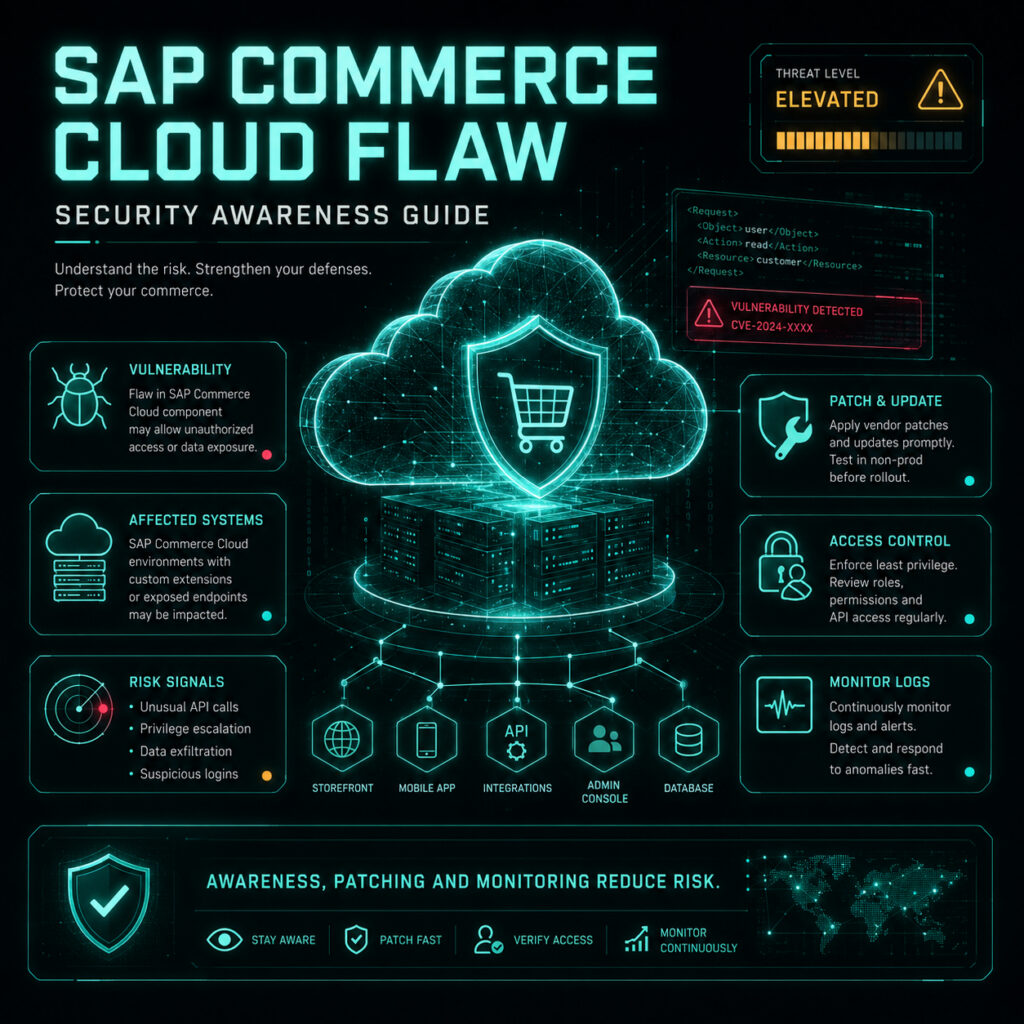
A critical SAP Commerce Cloud vulnerability is a reminder that enterprise security is rarely about one control, one team, or one patch cycle. When a vulnerability can be exploited without authentication, the technical exposure may be immediate—but the business response also depends on how quickly people recognize suspicious activity, report incidents, and follow security procedures.
On August 12, 2026, The Hacker News reported that SAP had released patches for CVE-2026-58231, a maximum-severity vulnerability affecting SAP Commerce Cloud’s Data Hub Adapter. The flaw is rated CVSS 10.0 and could allow an unauthenticated attacker to execute arbitrary code.
What is the SAP Commerce Cloud vulnerability?
CVE-2026-58231 is a critical SAP Commerce Cloud vulnerability involving insufficient authorization checks and input validation. It could allow an unauthenticated attacker to submit specially crafted input and ultimately execute arbitrary code on affected systems. The vulnerability affects the Data Hub Adapter component and carries a CVSS score of 10.0.
For organizations running SAP Commerce Cloud, this should be treated as a technical vulnerability-management priority. SAP’s current guidance also emphasizes staying on supported, current releases because update releases include security fixes and library updates.
Key takeaways
- CVE-2026-58231 affects SAP Commerce Cloud’s Data Hub Adapter.
- The vulnerability is rated CVSS 10.0, or critical.
- Exploitation does not require prior authentication.
- Successful exploitation could result in arbitrary code execution and compromise of application components.
- Organizations should prioritize SAP’s remediation guidance and verify that vulnerable environments have been updated and redeployed.
- Technical controls should be reinforced with Phishing Awareness Training and broader Human Risk Management.
- A Security Awareness Platform can help employees recognize related social-engineering activity and report suspicious messages quickly.
Why does an SAP vulnerability matter to security awareness teams?
At first glance, an application vulnerability appears to be an issue exclusively for CISOs, infrastructure teams, SAP administrators, and vulnerability-management teams. That is only part of the picture.
A critical flaw in a business-critical commerce environment can become one stage in a broader attack campaign. An attacker may combine exploitation with phishing, credential theft, social engineering, impersonation, or attempts to manipulate employees after gaining an initial foothold.
Security awareness therefore complements—not replaces—patching.
CISA recommends phishing training alongside technical safeguards and emphasizes that employees should understand how to identify and report suspicious activity.
This is where Human Risk Management becomes useful. Instead of treating employees as a compliance checkbox, organizations can identify risky behaviors, measure them, provide targeted education, and track whether behavior improves.
How could attackers use a critical vulnerability in a broader campaign?
The vulnerability itself is technical, but the surrounding attack chain may involve people.
Consider a hypothetical scenario:
- An attacker identifies an organization operating an exposed vulnerable commerce environment.
- The attacker attempts to exploit the technical weakness.
- After gaining access, the attacker searches for credentials, sensitive information, or additional systems.
- The attacker sends convincing messages to employees who may have access to business applications.
- An employee clicks a malicious link, discloses information, or follows a fraudulent request.
- The attacker uses the additional access to expand the compromise.
The exact attack path will depend on the organization’s architecture and controls. There is no basis for assuming that every organization affected by CVE-2026-58231 will experience this sequence.
The important lesson is that vulnerability management and workforce security operate in the same risk environment.
What should SAP Commerce Cloud customers do now?
The first priority is technical remediation.
SAP has released patches addressing the vulnerability, and reporting on the issue recommends moving to a fixed Commerce Cloud release and redeploying the updated environment. A temporary risk-reduction measure described by Onapsis is restricting access to the vulnerable endpoint with an IP Filter Set until remediation can be completed.
Security teams should:
- Identify affected SAP Commerce Cloud deployments.
- Confirm the exact Commerce Cloud version and relevant Data Hub Adapter configuration.
- Apply SAP’s recommended security update.
- Redeploy and verify the corrected environment.
- Review network exposure around affected endpoints.
- Check relevant application, authentication, and network logs for unusual activity.
- Coordinate vulnerability response with incident-response teams.
- Document remediation for compliance and risk reporting.
SAP also states that organizations should adopt the JDK21 and Spring 6 Framework Update before August 31, 2026, reinforcing the importance of maintaining supported Commerce Cloud releases.
Where does Phishing Awareness Training fit?
Phishing Awareness Training teaches employees how to identify, question, and report deceptive messages before those messages lead to credential theft, malware infection, unauthorized access, or data exposure.
For a vulnerability response program, training should be connected to realistic business situations rather than generic security tips.
For example, employees could receive simulations involving:
- A fake SAP security notification.
- A fraudulent request to review an account.
- A message claiming that an application update is overdue.
- A fake IT support request.
- A look-alike login page.
- A malicious QR code directing employees to a fraudulent portal.
- A vishing call pretending to be an administrator.
A suspicious URL checker can be useful as an additional defensive habit, but employees should not rely on a single tool. They should also inspect the sender, domain, context, urgency, and requested action—and use known communication channels to verify unusual requests.
CISA similarly recommends teaching users how to recognize suspicious messages and report them through established processes.
What should the best phishing simulation platform for businesses include?
The best phishing simulation platform for businesses should go beyond sending occasional fake emails.
A mature program should support:
Realistic scenarios
Simulations should reflect current threats, business processes, and employee roles. Finance, HR, executives, developers, and customer-support teams may encounter different attack patterns.
Multiple channels
Modern social engineering extends beyond email. Consider phishing, smishing, vishing, QR-code attacks, impersonation, and deepfake-enabled scenarios.
Behavioral measurement
Measure actions such as clicks, submissions, reports, repeat failures, and improvement over time rather than simply recording course completion.
Targeted remediation
Employees who repeatedly demonstrate risky behavior should receive focused education rather than identical training assigned to everyone.
Actionable reporting
Security leaders need metrics that connect awareness activity to organizational risk, including department-level trends and recurring behavioral weaknesses.
How does Human Risk Management improve vulnerability response?
Human Risk Management connects employee behavior with the broader security-risk picture.

Train people for the attacks they actually face.
Build stronger habits with phishing, vishing, smishing, deepfake and immersive simulations employees remember.
For example, an organization could identify employees who repeatedly click simulated phishing links, expose sensitive information during simulations, or fail to report suspicious activity. Those signals can inform targeted coaching and future simulations.
This approach also helps CISOs communicate with leadership. Instead of saying, “92% of employees completed training,” a security team can ask more meaningful questions:
- Are risky behaviors declining?
- Which departments have the highest exposure?
- Which roles require additional training?
- Are employees reporting suspicious messages faster?
- Are repeat-risk users improving?
- Which social-engineering scenarios are most effective against the organization?
Those measurements make awareness more operational and less administrative.
Common mistakes organizations make
Treating patching and awareness as separate programs
Patching closes a technical weakness. Awareness helps employees respond appropriately when attackers use deception around that weakness.
Running generic phishing campaigns
A generic “you have a package” simulation may not prepare employees for an attack themed around an urgent IT, finance, HR, or application-security request.
Measuring completion instead of behavior
Completion rates demonstrate participation. They do not necessarily demonstrate resilience.
Ignoring exposed identities
Organizations should understand whether employee credentials or corporate identities appear in known breaches and relevant underground sources. Dark web data breach detection can complement awareness programs by helping security teams identify exposure that may increase social-engineering risk.
Overlooking domain impersonation
Attackers can register domains that resemble legitimate corporate domains. Lookalike domain monitoring can help organizations identify potential impersonation infrastructure before employees encounter it.
What are practical attack surface best practices?
A strong response to a critical vulnerability should combine technology, people, and process.
Useful attack surface best practices include:
- Maintain an accurate inventory of internet-facing assets.
- Prioritize vulnerabilities based on severity, exposure, exploitability, and business impact.
- Apply vendor patches promptly.
- Restrict unnecessary network exposure.
- Monitor authentication and application activity.
- Use MFA and least-privilege access wherever appropriate.
- Establish clear incident-reporting procedures.
- Run realistic phishing and social-engineering simulations.
- Monitor relevant credential and domain exposure.
- Review and improve the program using measurable risk indicators.
This layered approach matters because no single security control is sufficient against a determined attacker.
How Cyberfrog can support security awareness programs
Cyberfrog is designed to help organizations turn security awareness into a continuous program rather than an annual compliance exercise.
Its platform combines phishing simulations with vishing, smishing, QR-code, deepfake, and immersive 3D scenarios. It also supports AI-assisted content creation, automated learning workflows, exposure monitoring, look-alike domain defenses, and human-risk reporting.
For organizations responding to emerging threats, the practical value is the ability to connect realistic simulations with measurable employee behavior. A security team can use threat intelligence and real incidents as the basis for targeted learning, then measure whether employees recognize and report similar scenarios.
The goal is not to replace vulnerability management. It is to strengthen the human layer around it.
FAQ
What is CVE-2026-58231?
CVE-2026-58231 is a critical SAP Commerce Cloud vulnerability affecting the Data Hub Adapter. It has a CVSS score of 10.0 and could allow an unauthenticated attacker to execute arbitrary code.
Does CVE-2026-58231 require authentication?
No. Public reporting describes the vulnerability as exploitable by an unauthenticated attacker through specially crafted input to affected functions.
What should SAP Commerce Cloud customers do?
Organizations should identify affected deployments, apply SAP’s security fix, redeploy the corrected environment, verify the running version, and review relevant logs and exposure. SAP recommends staying on current supported releases.
Can security awareness training prevent exploitation of SAP Commerce Cloud?
Training cannot patch a software vulnerability. However, it can reduce the likelihood that attackers successfully use phishing, impersonation, credential theft, or social engineering as part of a broader attack campaign.
Why use a Security Awareness Platform?
A Security Awareness Platform centralizes employee education, phishing simulations, behavioral measurement, reporting, and ongoing awareness activities. This makes it easier to manage security behavior as a continuous risk-management process.
What should Phishing Awareness Training cover?
Training should cover email phishing as well as smishing, vishing, malicious links, QR-code scams, impersonation, credential theft, deepfake-enabled social engineering, and appropriate incident reporting.
What is Human Risk Management?
Human Risk Management is the practice of identifying, measuring, and reducing security risk associated with employee behavior. It uses behavioral signals and targeted interventions rather than relying only on annual training completion.
How can organizations measure security awareness success?
Useful indicators include phishing-reporting rates, click and submission rates, repeat-risk behavior, time to report suspicious messages, training completion, knowledge assessment results, and changes in risk across departments or roles.
Conclusion
CVE-2026-58231 demonstrates why critical vulnerability response cannot stop at applying a patch. SAP Commerce Cloud customers should prioritize remediation, validate their exposure, review relevant telemetry, and follow SAP’s security guidance.
At the same time, organizations should consider what happens when attackers combine technical weaknesses with human manipulation.
A strong Security Awareness Platform helps turn emerging threats into practical employee training, realistic simulations, measurable behavior, and continuous Human Risk Management. When technical security and workforce resilience operate together, organizations are better positioned to detect, report, and contain attacks.
Try Cyberfrog for FREE to explore a modern approach to security awareness and human-risk reduction.
Disclaimer: Cyberfrogsecurity.com reports on publicly available threat-intelligence sources. Inclusion of an organization in an article does not imply confirmed compromise. All claims are attributed to external sources unless explicitly verified.
Make awareness training feel real.
Phishing, vishing, smishing, deepfake and 3D simulations with AI content and unified reporting.