
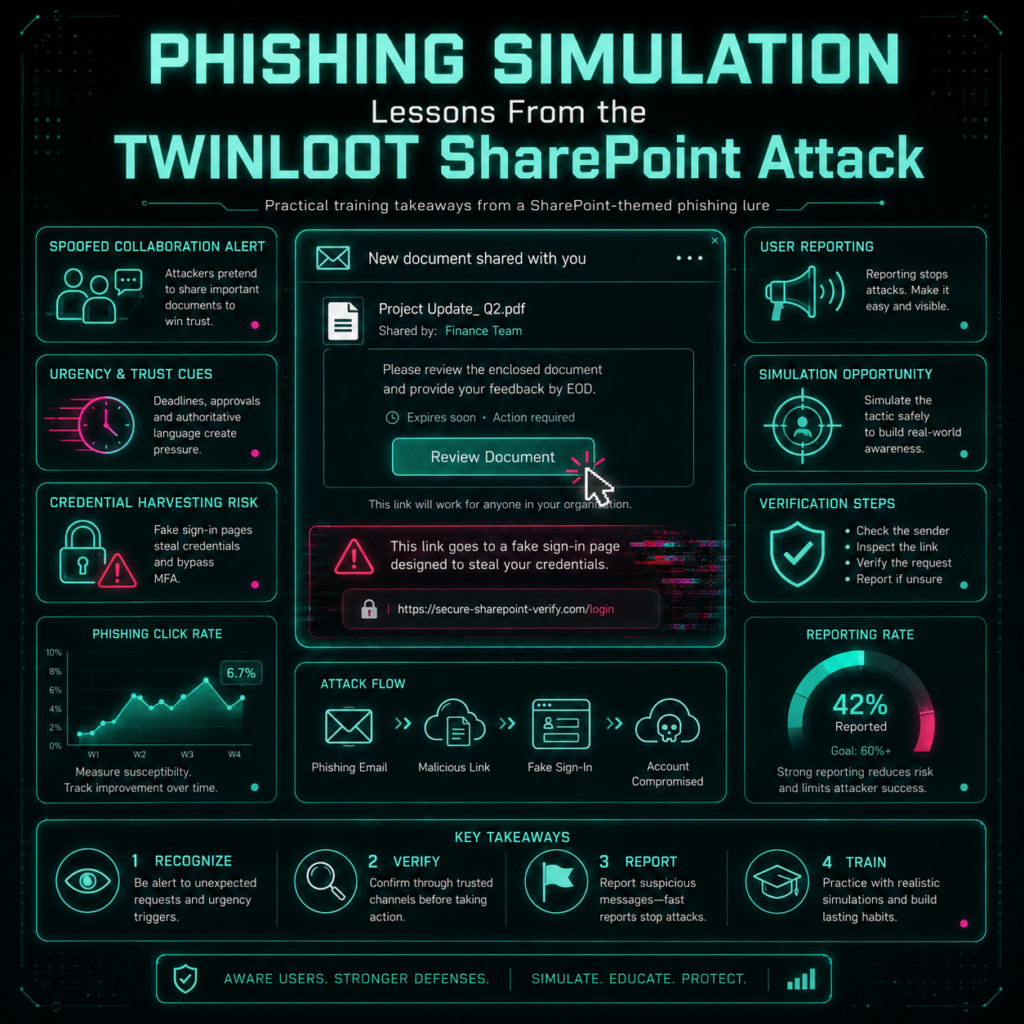
Although TWINLOOT reportedly abuses legitimate Microsoft collaboration services, the success of the campaign still depends on human interaction. Attackers do not necessarily need employees to disable security controls or install malware manually. Instead, they exploit familiar business workflows and trusted communication channels to encourage users to open shared documents, review files, or authenticate through convincing login prompts.
From a Human Risk Management perspective, this reinforces an important principle: employees should not be viewed as the weakest link. Rather, they represent a security control that can be strengthened through continuous learning, realistic practice, and supportive reporting processes.
Organizations should encourage employees to pause and verify requests involving:
- Unexpected SharePoint file-sharing notifications
- Microsoft Teams messages from unfamiliar contacts
- Requests to re-enter Microsoft 365 credentials
- External collaboration invitations that seem unusual
- Authentication prompts appearing outside normal workflows
Teaching employees to recognize these situations can reduce the likelihood of successful credential-phishing attempts while complementing technical controls such as identity protection and endpoint security.
What Security Teams Should Measure Beyond Click Rates
Measuring the effectiveness of a security awareness program requires more than tracking whether someone clicked a simulated phishing email.
Useful indicators include:
| Metric | Why It Matters |
| Reporting rate | Measures whether employees recognize and report suspicious activity. |
| Repeat simulation outcomes | Helps identify where additional coaching may be beneficial. |
| Training completion | Demonstrates participation, but not necessarily behavior change. |
| Knowledge assessments | Evaluates understanding of key security concepts. |
| Role-specific trends | Helps tailor future awareness content to different business functions. |
These metrics should be interpreted collectively. A single simulation outcome should never be treated as evidence that an employee would be compromised during a real attack.
How Security Awareness Training Can Reduce Similar Risks
Campaigns that abuse collaboration platforms demonstrate why annual compliance training alone is no longer sufficient.
Effective security awareness training with AI should evolve alongside attacker techniques and include scenarios employees are likely to encounter in their day-to-day work.
Relevant training topics include:
- Microsoft 365 credential phishing
- Fake document-sharing invitations
- Business Email Compromise (BEC)
- Multi-factor authentication best practices
- Safe handling of unexpected collaboration requests
- Credential protection
- Reporting suspicious communications
Scenario-based learning allows employees to practice recognizing realistic attacks before encountering them in production environments.
Why Phishing Simulation Matters
Phishing Simulation helps organizations evaluate how employees respond to realistic social-engineering scenarios in a safe, controlled environment.
Rather than measuring failure, simulations provide opportunities to:
- Reinforce secure decision-making
- Improve reporting behavior
- Identify training needs
- Adapt future awareness campaigns
- Measure behavioral improvement over time
Modern phishing simulations should reflect current attacker techniques rather than relying exclusively on generic email examples.
For example, simulations may safely reproduce scenarios involving document-sharing notifications, collaboration requests, or credential prompts without exposing employees to actual malicious infrastructure.
Combined with contextual education, these exercises can strengthen security culture while helping organizations better understand where additional guidance may be valuable.
Practical Recommendations for Organizations
Security teams responding to threats similar to the reported TWINLOOT activity should consider several defensive measures.
Strengthen Identity Security
- Require phishing-resistant multi-factor authentication where possible.
- Monitor for unusual authentication activity.
- Review conditional access policies regularly.
- Investigate impossible-travel and anomalous sign-in alerts.
Improve Collaboration Security
Review permissions granted to external users.
Limit unnecessary external sharing.
Monitor unusual Teams messaging activity.
Review SharePoint sharing configurations.
Enhance Incident Response
Prepare procedures for:
- Credential resets
- Session revocation
- Account investigations
- User notification
- Internal communication
- Threat hunting
Practicing these workflows before an incident occurs can improve response times.
Security Awareness Program Checklist
Organizations reviewing their awareness strategy can use the following checklist:
- Define the employee behaviors the program aims to improve.
- Align awareness topics with current phishing techniques.
- Deliver ongoing learning rather than annual-only training.
- Include realistic, authorized phishing simulations.
- Encourage employees to report suspicious messages.
- Provide supportive follow-up after simulations.
- Measure reporting trends as well as participation.
- Review role-specific risks across departments.
- Coordinate awareness initiatives with technical security controls.
- Update training content as attacker techniques evolve.
Frequently Asked Questions
What is a phishing simulation?
A phishing simulation is an authorized security exercise that presents employees with realistic but harmless phishing scenarios. Its purpose is to help organizations understand employee responses, reinforce secure behaviors, and identify opportunities for additional training without exposing users to genuine cyber threats.
Can security awareness training prevent credential theft?
Security awareness training cannot prevent every attack, but it can improve employees’ ability to recognize suspicious requests, report potential phishing attempts, and make safer decisions. Training works best when combined with technical controls such as MFA, email security, endpoint protection, and identity monitoring.
Why are collaboration platforms attractive to attackers?
Applications such as Microsoft Teams and SharePoint are trusted business tools that employees use every day. Messages and file-sharing requests received through these platforms may appear more credible than unsolicited emails, making them attractive channels for social-engineering campaigns.
What is Human Risk Management?
Human Risk Management focuses on understanding and improving security-related behaviors across an organization. Rather than blaming employees for mistakes, it uses education, simulations, behavioral insights, and continuous improvement to reduce the likelihood of successful social-engineering attacks.
Build Stronger Security Behaviors Through Continuous Practice
As attackers increasingly target trusted collaboration platforms, organizations should ensure that employees are prepared for more than traditional email phishing. Continuous security awareness training, realistic phishing simulations, and measurable Human Risk Management can help employees recognize evolving social-engineering techniques while supporting broader cybersecurity controls.

Train people for the attacks they actually face.
Build stronger habits with phishing, vishing, smishing, deepfake and immersive simulations employees remember.
Cyberfrog positions security awareness as an ongoing learning process rather than a once-a-year compliance exercise. By combining realistic phishing simulations with continuous employee education, organizations can strengthen security culture, reinforce positive behaviors, and better prepare employees for modern credential-phishing campaigns targeting platforms such as Microsoft 365.
Why Human Behavior Remains Central to the Attack Chain
Although TWINLOOT reportedly abuses legitimate Microsoft collaboration services, the success of the campaign still depends on human interaction. Attackers do not necessarily need employees to disable security controls or install malware manually. Instead, they exploit familiar business workflows and trusted communication channels to encourage users to open shared documents, review files, or authenticate through convincing login prompts.
From a Human Risk Management perspective, this reinforces an important principle: employees should not be viewed as the weakest link. Rather, they represent a security control that can be strengthened through continuous learning, realistic practice, and supportive reporting processes.
Organizations should encourage employees to pause and verify requests involving:
- Unexpected SharePoint file-sharing notifications
- Microsoft Teams messages from unfamiliar contacts
- Requests to re-enter Microsoft 365 credentials
- External collaboration invitations that seem unusual
- Authentication prompts appearing outside normal workflows
Teaching employees to recognize these situations can reduce the likelihood of successful credential-phishing attempts while complementing technical controls such as identity protection, endpoint security, and identity monitoring.
What Security Teams Should Measure Beyond Click Rates
Measuring the effectiveness of a security awareness program requires more than tracking whether someone clicked a simulated phishing email.
Useful indicators include:
| Metric | Why It Matters |
| Reporting rate | Measures whether employees recognize and report suspicious activity. |
| Repeat simulation outcomes | Helps identify where additional coaching may be beneficial. |
| Training completion | Demonstrates participation, but not necessarily behavior change. |
| Knowledge assessments | Evaluates understanding of key security concepts. |
| Role-specific trends | Helps tailor future awareness content to different business functions. |
These metrics should be interpreted collectively. A single simulation outcome should never be treated as evidence that an employee would be compromised during a real attack.
How Security Awareness Training Can Reduce Similar Risks
Campaigns that abuse collaboration platforms demonstrate why annual compliance training alone is no longer sufficient.
Effective security awareness training should evolve alongside attacker techniques and include scenarios employees are likely to encounter in their day-to-day work.
Relevant training topics include:
- Microsoft 365 credential phishing
- Fake document-sharing invitations
- Business Email Compromise (BEC)
- Multi-factor authentication best practices
- Safe handling of unexpected collaboration requests
- Credential protection
- Reporting suspicious communications
Scenario-based learning allows employees to practice recognizing realistic attacks before encountering them in production environments.
Why Phishing Simulation Matters
Phishing Simulation helps organizations evaluate how employees respond to realistic social-engineering scenarios in a safe, controlled environment.
Rather than measuring failure, simulations provide opportunities to:
- Reinforce secure decision-making
- Improve reporting behavior
- Identify training needs
- Adapt future awareness campaigns
- Measure behavioral improvement over time
Modern phishing simulations should reflect current attacker techniques rather than relying exclusively on generic email examples.
For example, simulations may safely reproduce scenarios involving document-sharing notifications, collaboration requests, or credential prompts without exposing employees to actual malicious infrastructure. When combined with contextual education, these exercises strengthen security culture and provide actionable insights into where additional awareness training is needed.
Practical Recommendations for Organizations
Security teams responding to threats similar to the reported TWINLOOT activity should consider several defensive measures.
Strengthen Identity Security
- Require phishing-resistant multi-factor authentication where possible.
- Monitor for unusual authentication activity.
- Review conditional access policies regularly.
- Investigate impossible-travel and anomalous sign-in alerts.
Improve Collaboration Security
- Review permissions granted to external users.
- Limit unnecessary external sharing.
- Monitor unusual Teams messaging activity.
- Review SharePoint sharing configurations.
Enhance Incident Response
Prepare procedures for:
- Credential resets
- Session revocation
- Account investigations
- User notification
- Internal communication
- Threat hunting
Practicing these workflows before an incident occurs can significantly improve response times and reduce the impact of credential-based attacks.
Security Awareness Program Checklist
Organizations reviewing their awareness strategy can use the following checklist:
- Define the employee behaviors the program aims to improve.
- Align awareness topics with current phishing techniques.
- Deliver ongoing learning rather than annual-only training.
- Run authorized and ethical phishing simulations.
- Encourage employees to report suspicious messages.
- Provide immediate educational feedback after simulations.
- Measure reporting trends as well as participation.
- Review role-specific risks across departments.
- Coordinate awareness initiatives with technical security controls.
- Update training content as attacker techniques evolve.
Frequently Asked Questions
What is a phishing simulation?
A phishing simulation is an authorized security exercise that presents employees with realistic but harmless phishing scenarios. Its purpose is to help organizations evaluate security behaviors, reinforce safe decision-making, and identify opportunities for additional training without exposing users to genuine cyber threats.
Can security awareness training prevent credential theft?
Security awareness training cannot stop every attack, but it helps employees recognize suspicious requests, report phishing attempts, and make better security decisions. It is most effective when combined with controls such as multi-factor authentication, endpoint protection, email security, and identity monitoring.
Why are Microsoft Teams and SharePoint attractive to attackers?
Because these platforms are trusted and widely used for business collaboration, employees are more likely to engage with messages and shared files they receive through them. Attackers exploit that familiarity to increase the credibility of phishing campaigns.
What is Human Risk Management?
Human Risk Management is a continuous approach to improving security-related behaviors across an organization. It combines awareness training, phishing simulations, behavioral insights, and measurable outcomes to reduce the likelihood of successful social-engineering attacks without blaming employees.
Turn Security Awareness Into Better Security Decisions
The reported TWINLOOT campaign is another reminder that attackers continue to exploit trusted collaboration platforms and employee behavior to obtain credentials. Organizations that combine technical defenses with continuous security awareness training, realistic phishing simulations, and Human Risk Management are better positioned to reduce risk and improve resilience against evolving phishing techniques.
Cyberfrog helps organizations build stronger security cultures through engaging security awareness training and realistic phishing simulations that prepare employees for the attacks they are most likely to encounter. By continuously reinforcing secure behaviors instead of relying solely on annual compliance training, organizations can better measure progress and strengthen their overall cyber resilience.
Contact us NOW to learn how Cyberfrog can help your organization build a measurable, continuous security awareness program with realistic phishing simulations that improve employee readiness against today’s evolving social engineering threats.
Disclaimer: Cyberfrogsecurity.com reports on publicly available threat-intelligence sources. Inclusion of an organization in an article does not imply confirmed compromise. All claims are attributed to external sources unless explicitly verified.
Make awareness training feel real.
Phishing, vishing, smishing, deepfake and 3D simulations with AI content and unified reporting.