
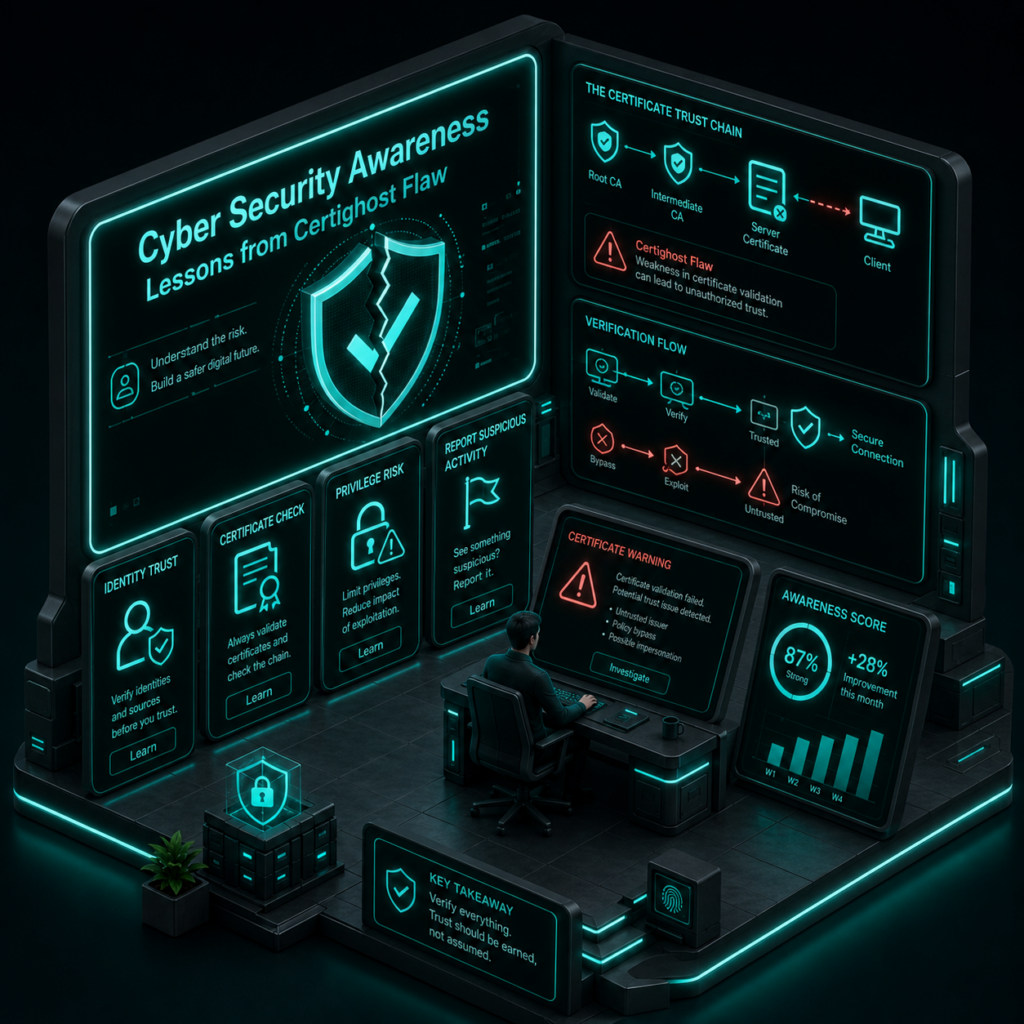
Cyber Security Awareness is no longer limited to recognizing phishing emails or creating strong passwords. Modern cyber threats increasingly target the infrastructure that organizations rely on for identity, authentication, and trust. Microsoft’s recent patch for the Certighost vulnerability demonstrates how flaws in enterprise certificate services can potentially allow attackers to impersonate a Domain Controller, opening the door to privilege escalation and widespread network compromise.
The vulnerability, tracked by security researchers and addressed through Microsoft’s latest security updates, underscores the importance of keeping systems fully patched while educating both IT administrators and employees about emerging attack techniques. 🔐
Although this flaw requires specific conditions to exploit, its potential impact highlights why organizations must combine technical defenses with continuous employee education. A mature security strategy integrates patch management, identity protection, and ongoing awareness programs to minimize both technical and human risk.
Understanding the Certighost Vulnerability
The Certighost vulnerability affects Active Directory Certificate Services (AD CS), one of the most important identity components in many Windows enterprise environments.
Certificate Services enable organizations to issue digital certificates for users, devices, and services. These certificates help establish trust across networks and support secure authentication.
According to Hackread, researchers discovered that under certain conditions, attackers could manipulate certificate issuance in ways that allowed them to impersonate a Domain Controller. If successful, this could provide elevated privileges and unauthorized access to critical enterprise resources.
Fortunately, Microsoft released security updates that mitigate the vulnerability before widespread exploitation was reported.
Organizations should also prioritize exposed asset discovery to identify publicly accessible systems that could increase the risk of identity-based attacks if left unpatched. 🛡️
Why Domain Controller Impersonation Is Dangerous
Domain Controllers are often described as the “keys to the kingdom.”
They authenticate users, enforce security policies, manage permissions, and control access throughout enterprise environments.
If attackers successfully impersonate a Domain Controller, they may be able to:
- Authenticate as trusted systems
- Escalate privileges
- Access confidential business information
- Deploy malware across networks
- Create persistent backdoors
- Disable security controls
Organizations should complement patch management with a malware URL scanner to identify malicious links that attackers may use to gain an initial foothold before attempting privilege escalation.
Because of their central role, protecting identity infrastructure should remain a top cybersecurity priority.
Lessons Every Organization Should Learn
The Certighost vulnerability illustrates several important security lessons.
First, vulnerabilities affecting identity services often have consequences far beyond a single server.
Second, delayed patching increases organizational exposure even when exploitation appears technically complex.
Third, cybersecurity depends on both technology and people.
This is where Cyber Security Awareness programs become essential. Employees and administrators alike must understand how identity systems work, why timely patching matters, and how attackers exploit trust relationships.
Organizations should also consider integrating a real-time dark web monitoring solution to identify compromised credentials that could be used alongside identity-based attacks, while a lookalike domain detection tool helps detect fraudulent domains designed to impersonate trusted brands and distribute phishing campaigns.
Security awareness should extend beyond phishing to include authentication, certificates, privileged accounts, and secure administrative practices.
How Security Awareness Strengthens Technical Defenses
Many organizations mistakenly believe awareness training only benefits non-technical employees.
In reality, IT administrators also benefit from continuous education.
Modern Security Awareness Software helps organizations educate employees about:
- Identity attacks
- Credential theft
- Privilege escalation
- Secure authentication
- Certificate security
- Patch management responsibilities
Well-designed awareness initiatives reduce configuration errors while improving overall security culture.
Combined with vulnerability management, Security Awareness Software becomes a valuable layer of defense rather than simply a compliance requirement. 📚
Human Risk Remains a Critical Factor
Technical vulnerabilities rarely operate in isolation.
Attackers often combine software flaws with human error.
Examples include:
- Administrators delaying security updates
- Weak privileged account management
- Excessive user permissions
- Misconfigured certificate services
- Poor change management
- Inadequate monitoring
Reducing these risks requires an effective Human Risk Management strategy that measures behavior alongside technical controls.
Organizations increasingly recognize that employee actions directly influence cybersecurity resilience.
Rather than blaming users, successful security programs focus on education, reinforcement, and measurable improvement.
Practical Checklist for Security Teams
Security leaders should consider the following best practices after vulnerabilities like Certighost emerge.
✅ Apply Microsoft security updates promptly
✅ Audit Active Directory Certificate Services configurations
✅ Review certificate issuance policies
✅ Restrict administrative privileges
✅ Monitor authentication logs
✅ Enable privileged account monitoring
✅ Conduct regular vulnerability assessments
✅ Train administrators on certificate security
✅ Test disaster recovery procedures
This layered approach reduces opportunities for attackers while improving organizational resilience. ✅
Question: Should Every Organization Patch Immediately?
Yes.
Organizations using Windows Server environments with Active Directory Certificate Services should prioritize Microsoft’s security updates according to official guidance.
Even when no active exploitation has been reported, delaying security patches increases exposure over time.
Patch management remains one of the most effective methods for preventing privilege escalation attacks and protecting enterprise identity infrastructure.
Beyond Patching: Building Long-Term Security
Patching vulnerabilities is only one part of cybersecurity maturity.
Organizations also need continuous monitoring, configuration reviews, identity governance, and employee education.
A strong Human Risk Management program helps identify risky behaviors before they contribute to successful cyberattacks.
Security leaders should regularly evaluate:
| Security Area | Recommended Action |
| Patch Management | Apply updates quickly |
| Identity Security | Review certificate services |
| Privileged Accounts | Limit administrator access |
| User Awareness | Conduct continuous education |
| Monitoring | Detect abnormal authentication |
| Incident Response | Practice recovery exercises |
These practices significantly improve organizational resilience against identity-based attacks.
Why Awareness Training Still Matters
Some organizations assume infrastructure vulnerabilities only concern IT departments.
However, many attacks begin with phishing, credential theft, or social engineering before attackers attempt privilege escalation.
This is why Cyber Security Awareness must remain a continuous process rather than an annual exercise.
Employees who recognize suspicious behavior often become the first line of defense.
Likewise, administrators who understand certificate security are less likely to introduce configuration weaknesses that attackers can exploit.
Modern awareness programs should include realistic attack scenarios, identity security concepts, and incident reporting procedures. 💡
Organizations evaluating the Best phishing simulation platform for businesses should look for solutions that combine realistic simulations with measurable learning outcomes instead of relying solely on compliance metrics.
Similarly, immersive 3D security awareness training can improve engagement by allowing employees to experience real-world attack scenarios in interactive environments.
How Cyberfrog Security Helps Organizations
Building cyber resilience requires more than simply reacting to vulnerabilities.
Cyberfrog Security provides resources that help organizations strengthen employee awareness while improving organizational readiness against evolving cyber threats.
Organizations can combine awareness initiatives with technical controls to reduce both infrastructure risks and human vulnerabilities. 🚀
Expert Perspective
Microsoft’s rapid response to Certighost demonstrates an important principle followed throughout cybersecurity:
“Identity infrastructure should always be treated as mission-critical because trust is the foundation of enterprise security.”
Organizations that continuously update systems while educating employees are significantly better positioned to withstand modern attacks.
Conclusion
The Certighost vulnerability is another reminder that attackers increasingly target identity systems rather than traditional endpoints alone.
Microsoft’s security update helps mitigate the immediate risk, but long-term resilience requires a broader strategy that combines patch management, secure configurations, employee education, and continuous improvement.
By investing in Cyber Security Awareness, implementing effective Security Awareness Software, and strengthening Human Risk Management, organizations can significantly reduce their exposure to both technical vulnerabilities and human error. 🔒📈
📖 Discover much more in our complete guide
Disclaimer: Cyberfrogsecurity.com reports on publicly available threat-intelligence sources. Inclusion of an organization in an article does not imply confirmed compromise. All claims are attributed to external sources unless explicitly verified.